Data app
Asteroid Explorer
A live 3D solar system showing about 2,500 potentially hazardous asteroids from JPL data. Curious non-experts can circle up to four, see how big they are, how close they come and whether they're dangerous, all in plain words.
Shared by Metabase team
Screenshots
Distilled prompt
Follow our guide to build your own version: Get started (opens in a new tab)
Build a Metabase data app called Asteroid Explorer: a live 3D map of near-Earth asteroids on their real orbits, for curious non-experts. Give every number a plain-language meaning.
Data (read-only saved questions over asteroid tables):
- Hazardous orbits: the ~2,500 potentially hazardous asteroids from ast_neo_orbits (is_pha = 1), split into two questions by discovery year (before and since 2008). Columns: designation, full_name and the orbital elements (a_au, e, i_deg, node_deg, peri_deg, mean_anomaly_deg, mean_motion_deg_day, epoch_jd).
- NEO details: any of ~42k near-Earth asteroids, searched by name or designation. Adds orbit_class, discovery_year, period_years, moid_au, diameter_km, abs_magnitude_h, n_obs_used and impact risk (torino_max, palermo_cum, impact_probability, impact_year_range).
- Close approaches (ast_close_approaches): des, approach_at, dist_lunar, dist_km, v_rel_kms.
- Torino history (ast_torino_history): des, event_date, torino, event.
No write actions.
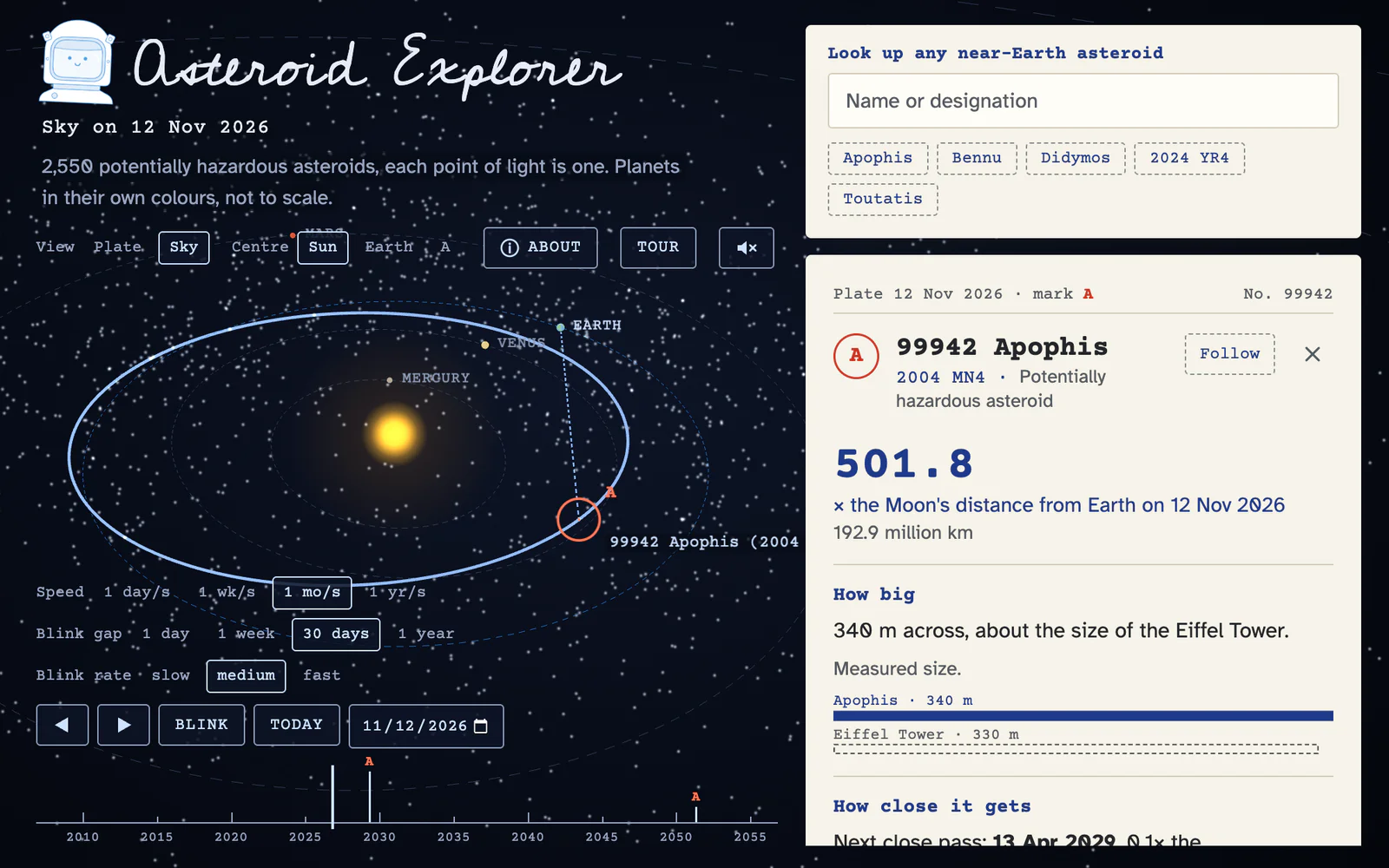
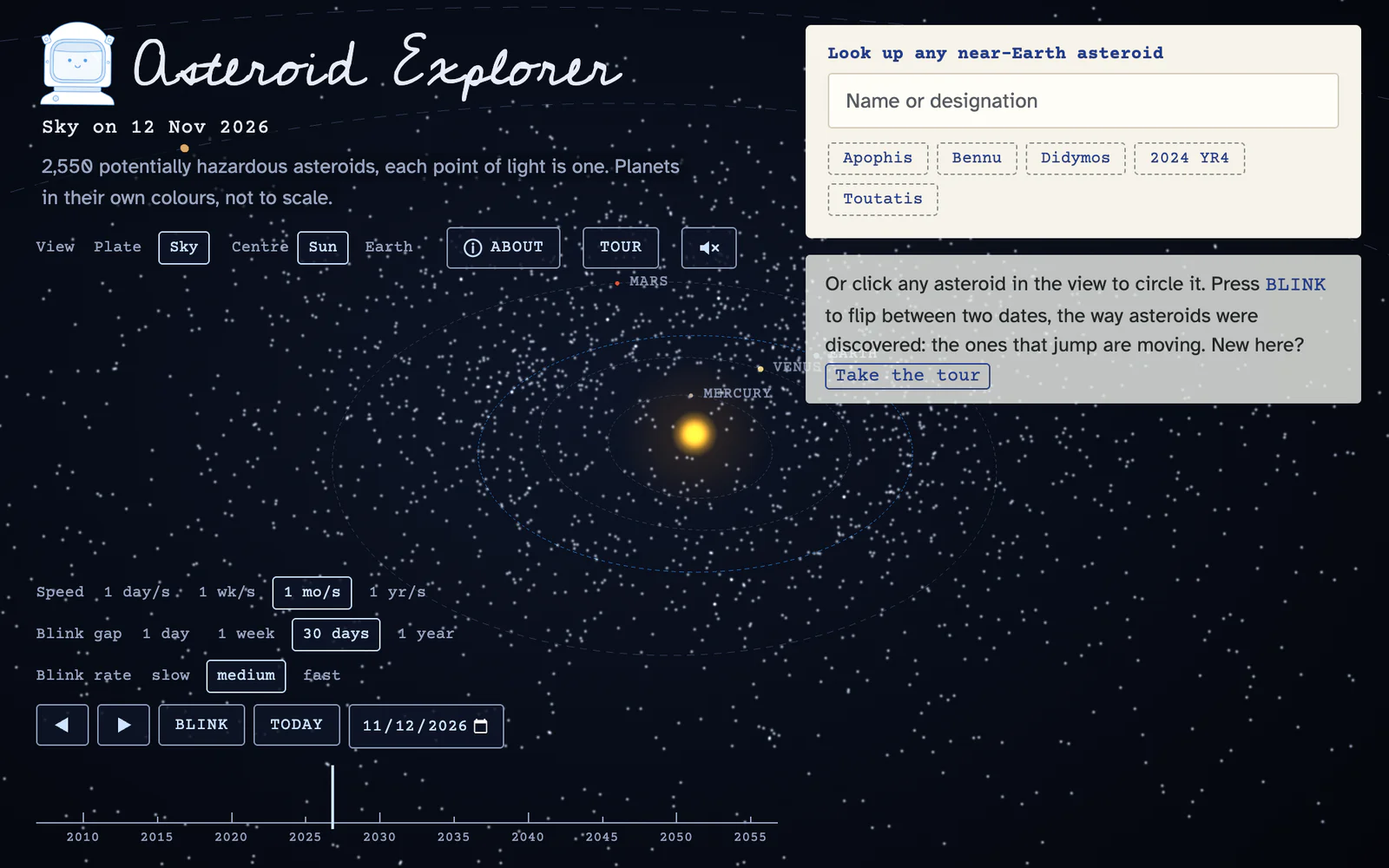
Main view: a full-screen three.js solar system. Compute positions in the browser with a two-body Kepler solution. Draw the Sun, planets, orbits and each hazardous asteroid as a speck. Click a speck, or search, to "circle" up to four asteroids, marked A to D, with their orbits drawn.
Right-hand stack of cards, one per circled asteroid:
- How big: size (measured or estimated) next to a familiar object.
- How close it gets: next pass in Moon distances, closest on record, a "watch this pass from Earth" button, and a 50-year log-scale distance chart. Clicking the chart jumps to that date.
- Is it dangerous: odds as "1 in N", Torino and Palermo explained in words.
- Its story: discovery year, orbit class, year length, observation count, Torino history.
- Follow and remove buttons.
With nothing circled, show search with suggestion chips (Apophis, Bennu, Didymos, 2024 YR4, Toutatis).
Bottom time rail: date stamp, play backward or forward at chosen speeds, a date picker, and ticks for circled asteroids' close passes. Picking a date names the hazardous asteroid closest to Earth that day, with a "Circle it" button. BLINK mode flips between two dates 30 days apart.
Toolbar: View (Plate or Sky), Centre on Sun, Earth or a circled asteroid, an About the data dialog, a guided Tour of seven notable asteroids (Apophis 2029, Florence, Didymos, Bennu, Phaethon...) with pause, back and next, and ambient sound that rises as asteroids near Earth.
Look and feel: "the discovery plate". A pale backlit glass negative with a soft vignette, dark specks, the Sun as a burned disc, graphite dashed planet orbits, no glow. Blue-black ink for annotations; red only for selection rings and A to D letters. Data sits on warm off-white card-stock sleeves. Fonts: handwritten cursive title, Courier Prime for labels and numbers, Atkinson Hyperlegible for prose. Sky mode is colour on black. On narrow screens, stack cards below the scene. Be honest about risk; never dramatize.