


Metabase vs. Amazon QuickSight
Which is right for my team?

Metabase is the easy-to-use AI analytics platform with a friendly UX that lets everyone work with data, on any database, with AI capabilities included in every plan and no AWS account required.

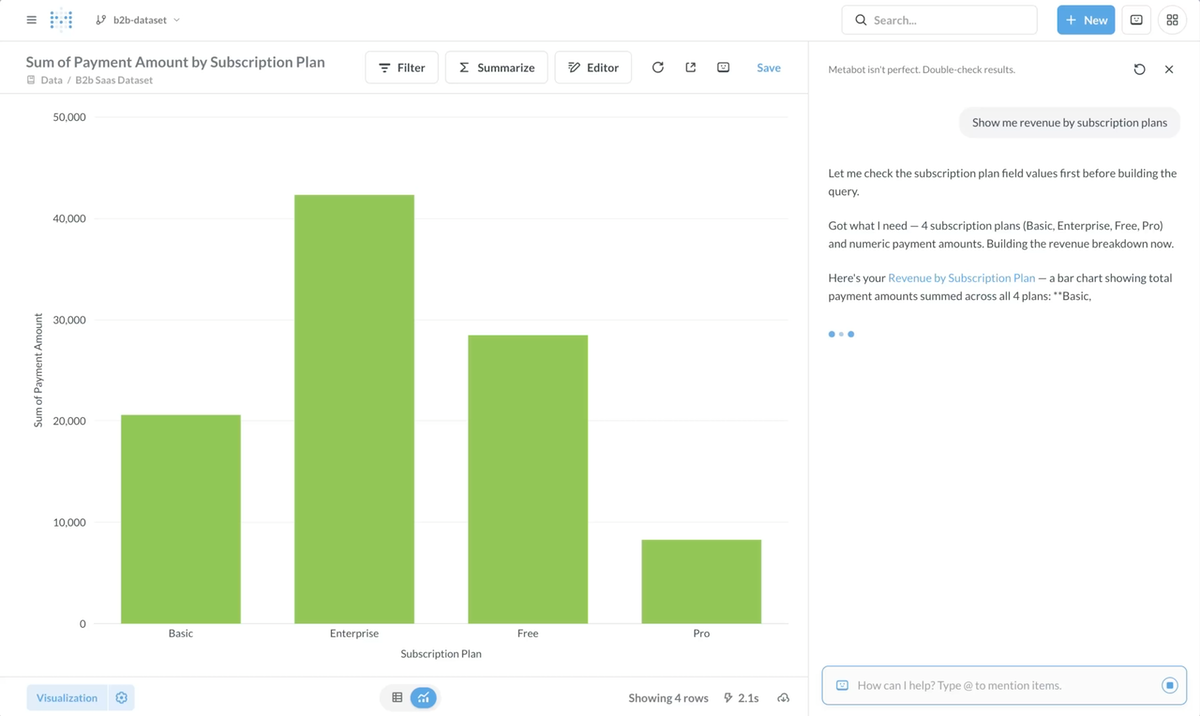
Metabot answering a natural-language question and building a revenue chart in Metabase

Metabase is trusted by 100,000+ companies

huggingface logomcdonalds logohuma logocapital-one logoMistral AI logolinear logoDeutsche Telekom logokong logo

What's the difference between Metabase and Amazon QuickSight?

TL;DR QuickSight is AWS-native, which is great if your whole stack lives in AWS and you want analytics on the same bill. The trade-offs are lock-in and a pricing model that gets complicated fast, with Standard and Enterprise editions, four user roles, session-based capacity for embedding, and a separate account fee once you turn on the AI. Metabase runs anywhere, connects to 20+ databases, and includes AI in every plan, including the free open source one.

What makes Metabase a good choice compared to QuickSight?

  • Built-in AI, accessible for everyone. Metabot lets anyone ask questions in plain language and get answers grounded in your data, in every edition including open source (powered by your LLM provider). QuickSight includes basic question-and-answer, but the features that actually build things for you, AI-authored dashboards, executive summaries, and generated data stories, sit in its Pro roles at $20 to $40 per user per month, on top of an account fee once you switch them on.
  • One plan, not four user roles. QuickSight splits people across Reader, Reader Pro, Author, and Author Pro, and gates SSO, row-level security, and embedding behind Enterprise Edition. Metabase has transparent pricing and puts fine-grained permissions and SSO in front of you without an edition upgrade.
  • Embedded analytics without session math. Customizable embedded analytics that lets your customers explore their data, without pricing your product against 30-minute session counts and per-session overages.
  • Runs anywhere, on any servers. Self-host it, or let us run it. Metabase Cloud is available on Pro and Enterprise at no extra cost, and Metabase connects to 20+ databases, so you are not tied to one cloud provider.
  • Your infrastructure, your model. Self-host Metabase and power AI with your own LLM provider's API key. Your data, your infrastructure, your model spend.
  • Easy for everyone to use. Intuitive tools like interactive dashboards with quick drill-through analyses, the query builder to write questions without SQL, and one-click-to-create charts.
  • Help from our world-class Success team. Fast, direct help from technical experts, not a support queue. Customers love them.
  • Private and secure. We never look at or copy your data. And we prioritize privacy and security features to secure data access in your org, like SSO and fine-grained permissions.

When might QuickSight be a better fit than Metabase?*

  • Your whole stack already lives in AWS, and you want Redshift, Athena, and S3 analytics on the same bill.
  • You have AWS committed spend or credits to burn, which can make QuickSight effectively free at the margin.
  • You want IAM and VPC-native access control rather than managing another permissions layer.
  • Your viewers are genuinely occasional, where session-based pricing can work out cheaper than per-seat.
  • You only want some of your people querying your data.
*For the record... Plenty of Metabase customers run happily on AWS, querying Redshift, Athena, and RDS. The question usually isn't whether you're on AWS, it's whether your analytics should be locked to it. (We're trying to present a somewhat balanced view here, but c'mon, it's still our website 😏)
“Metabase was the embedded solution we were looking for - easy-to-integrate, customizable and performant.”
Ian Meyers

Co-founder, Sincera

Frequently asked questions

When is Metabase a better choice than Amazon QuickSight?

Metabase suits teams who want everyone to self-serve analytics without an AWS account, an edition upgrade, or a per-role pricing table to decode. It runs on any database, self-hosted or on our cloud, and includes AI in every plan. It's BI your team will actually enjoy using, at the right price for your scale.

Does Metabase have AI like Amazon Q in QuickSight?

Yes, and the pricing works differently. Metabot lets anyone ask questions in plain language and is included in every Metabase edition, including the free open source one. QuickSight includes basic natural-language question-and-answer with its standard Reader and Author roles. The features that generate content for you, like AI-authored dashboards, executive summaries, and written data stories, live in its Reader Pro and Author Pro roles at roughly $20 and $50 per user per month, and switching them on adds a monthly account-level fee. With Metabase, AI isn't a separate line item.

How does embedded analytics pricing compare?

QuickSight embedding usually lands on session-based capacity pricing, where you buy blocks of 30-minute sessions and pay an overage per session beyond that. That can be hard to forecast when your product grows or usage spikes. Metabase offers embedded analytics with published pricing, so you can model your costs before you ship.

Do I need an AWS account to use Metabase?

No. Metabase runs wherever you want it, self-hosted on your own infrastructure or on Metabase Cloud, and connects to 20+ databases. Plenty of our customers do run on AWS and query Redshift, Athena, or RDS, they just aren't locked to it.

When is QuickSight a better choice than Metabase?

Credit where it's due - if your organisation is all-in on AWS, QuickSight's native integration with Redshift, Athena, and S3 is genuinely convenient, and consolidated AWS billing matters to some finance teams. If you have committed AWS spend to draw down, the economics can look very good. It's a reasonable choice for AWS-centric shops with occasional viewers.

Who uses Metabase over QuickSight?

Metabase is trusted by over 100,000 companies, from startups who need their first business intelligence tool through to Enterprises. Metabase open source is the go-to choice for founders and developers who want their teams answering their own questions. Metabase Pro and Enterprise is generally chosen by CTOs, CPOs, and Heads of Data who need self-service analytics to actually happen, and who want their analytics portable across clouds.

Do you need to know SQL to use Metabase or QuickSight?

Both let analysts work in SQL and less technical people ask questions without it. Metabase's intuitive Query Builder lets non-technical or data savvy people put together analyses with clicks - no SQL necessary. Analysts who prefer to write SQL can fill their boots in the SQL editor.

What's the difference in pricing between Metabase and QuickSight?

Metabase is open source and free to self-host, with transparent paid plans for extra security, governance, cloud hosting, and support. QuickSight prices per user across four roles, splits features between Standard and Enterprise editions, uses separate session-based capacity pricing for embedding, and adds an account-level fee when you enable its Pro AI features. Both can be cost-effective, but Metabase is a lot easier to forecast.

Ok, give it to me straight though - what's the best Business Intelligence tool?

There's no right or wrong answer here. It depends on your use case, how much you want people exploring data on their own, your existing cloud stack, how fast you need to get going, and your budget.

If you're curious about how other BI tools compare, check out our Metabase Alternatives post.

Again, there's no “right” answer, but just sayin' - Metabase will let everyone on your team work with data, runs on any database in any cloud, gets up and running in 5 minutes flat, and you can try it for free.

Have more questions? We'd be happy to help.
Talk to a person

Learn more about Metabase