


Metabase vs. Omni
Whose infrastructure is your data on?

Metabase is the AI analytics platform you can run yourself. Self-hosted, air-gapped, or on our cloud — your data never has to leave your network. A semantic layer you build in the UI, AI and MCP in every plan including open source, and pricing published on the website, so you don't need a demo call to find out what it costs.

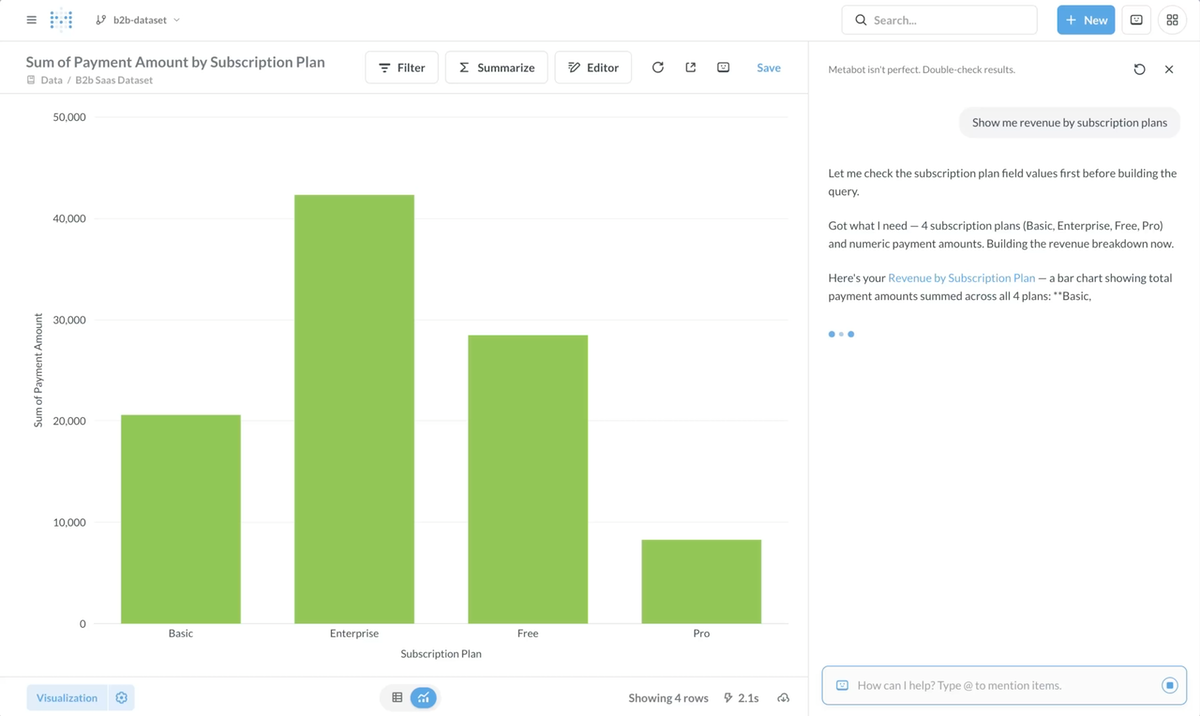
Metabot answering a natural-language question and building a revenue chart in Metabase

Metabase is trusted by 100,000+ companies

huggingface logomcdonalds logohuma logocapital-one logoMistral AI logolinear logoDeutsche Telekom logokong logo

What's the difference between Metabase and Omni?

Omni was built by the team behind Looker, and it shows — a deep, code-first modeling layer with git version control and two-way dbt sync, sold through a demo call and run in Omni's cloud. Metabase takes the other route. Data Studio gives you transforms, models, metrics and shared definitions without a modeling language to learn, AI and MCP come in every plan including open source, and you decide where the whole thing runs.

Why teams choose Metabase over Omni

  • You choose where it runs. Self-host it, run it on Metabase Cloud, or deploy air-gapped on Enterprise. Omni runs in Omni's cloud. For regulated industries and anyone whose security review reaches their analytics stack, this decides it on its own.
  • You can see the price. Metabase pricing is published, from free open source through Pro and Enterprise, and you can check out without a call. Omni's pricing is quote-only — every plan goes through a demo first.
  • Affordable enough to roll out to everyone. Self-service analytics only works if the whole company is in the tool, not just the analysts.
  • A semantic layer without a modeling language. Data Studio is where you transform raw data into analytics-ready tables and define metrics and shared definitions — through the UI, no DSL to learn, no analytics engineer required to change a metric.
  • AI and MCP in every plan, including open source. Metabot and the MCP server ship with every edition. Bring your own API key from Anthropic, OpenAI, AWS Bedrock or Azure — we're not in the business of selling you tokens.
  • Useful on day one. Connect a database and start exploring in under five minutes. The model can come later, you don't have to do anything before you start exploring your data.
  • Embedded analytics included. Multi-tenant embedding, row- and column-level security, and whitelabeling come with Pro. And you can self-host that too.

When might Omni be the better fit for my team?

  • You're happy for your analytics to run on a vendor's infrastructure, and data residency isn't part of your security review.
  • Your analytics engineers own every metric definition in dbt and you want to write those definitions back to the repo from inside the BI tool.
  • Your finance team lives in spreadsheets and wants hundreds of Excel functions running directly against the warehouse.
  • You're leaving Looker, you liked the LookML mental model, and you have the budget you were already spending on Looker.
“It's the first time in my years working in data that I saw non-technical business users create their own dashboards and analytics in our BI platform, all made possible because of Metabase's user friendly and intuitive data exploration and dashboarding capabilities.”
Dobo Radichkov

Chief Data Officer, Holland & Barrett

Frequently asked questions

How much does Metabase cost compared to Omni?

Metabase pricing is on the pricing page — a free open-source edition, Starter and Pro plans you can buy with a card, and Enterprise for larger deployments. Omni doesn't publish pricing; you request a demo and receive a quote based on your user count. Teams who've priced both tell us Metabase comes in well below.

Can I self-host Metabase? Can I self-host Omni?

Metabase can be self-hosted — the open-source edition, and Pro and Enterprise plans too — run on Metabase Cloud, or deployed air-gapped on Enterprise. Omni is a hosted cloud service; you can choose which cloud region your instance runs in, but the application runs in Omni's environment. For teams whose data residency or security requirements extend to their analytics tooling, that's usually the deciding factor.

Does my data leave my network when I use Metabase?

It doesn't have to. Metabase performs in-database analytics — queries are sent to your database and the results come back. Nothing is extracted from your database, and nothing is stored by Metabase unless you choose to. Self-host it and the whole system runs on servers you control, with no third party in the path.

Does Metabase have a semantic layer like Omni?

Yes. Data Studio is where you build it: transform raw data into analytics-ready tables, define metrics, and set shared definitions your whole organization queries against. The difference is how you build it — Metabase's is built through the UI with no modeling language to learn, while Omni's is a code-first YAML and git workflow aimed at analytics engineers.

Does Metabase integrate with dbt?

Metabase works on top of the tables dbt builds, and Data Studio lets you model and define metrics on them. Omni goes further here with a two-way sync that writes model changes back into dbt. If your team's entire workflow is centered on dbt and you want to edit dbt models from inside your BI tool, that's a real difference worth weighing.

Which is easier for non-technical people to use?

Metabase, by design — it's what the product was built for. The query builder lets anyone filter, summarize and chart with clicks, and dashboards are built to be drilled into rather than just looked at. Omni's reviewers note that its power comes after the semantic model is set up, and that onboarding non-technical users takes real time and support.

We were using Explo. Can Metabase replace it?

Yes. Explo was acquired by Omni in October 2025 and its customers are migrating — we've talked to several who are weighing their options. If you're weighing that migration, Metabase offers multi-tenant embedded analytics with row- and column-level security, whitelabeling and interactive embeds on Pro — on published pricing, and self-hostable if you'd rather your customers' data didn't leave your infrastructure. Talk to a person and we'll walk through the migration.

When is Metabase a better choice than Omni?

When where the software runs is part of your decision, when you want everyone in the company working with data rather than a small analyst team, and when you need to know what it costs before you book a call. Metabase can be self-hosted or air-gapped, publishes its pricing, and offers a free open-source edition.

When is Omni a better choice than Metabase?

Credit where it's due. Omni is built by the people who built Looker and the modeling layer is excellent — git-versioned, code-first, with two-way dbt sync and spreadsheet-style workbooks. If your analytics engineers own every definition, your finance team works in Excel formulas against the warehouse, and running on a vendor's infrastructure is fine by your security team, Omni is a strong fit.

What's the best business intelligence tool?

It depends on your use case, budget, where your data is allowed to live, and how many people need to work with data. If you're comparing options more broadly, our Metabase Alternatives post lays out how we stack up against Omni, Looker, Tableau, Power BI, Hex, Lightdash and others.

But if you want everyone on your team using it, need to run it on your own infrastructure, and would rather read a price than book a call, try Metabase free.

Have more questions? We'd be happy to help.
Talk to a person

Learn more about Metabase