





What is collaboration response time, and how do you measure it in Metabase?
Collaboration response time is the elapsed time from a question, request, or new thread to its first useful human reply. It exposes slow handoffs and unattended work without rewarding raw message volume.
What does a collaboration response time chart look like in Metabase?
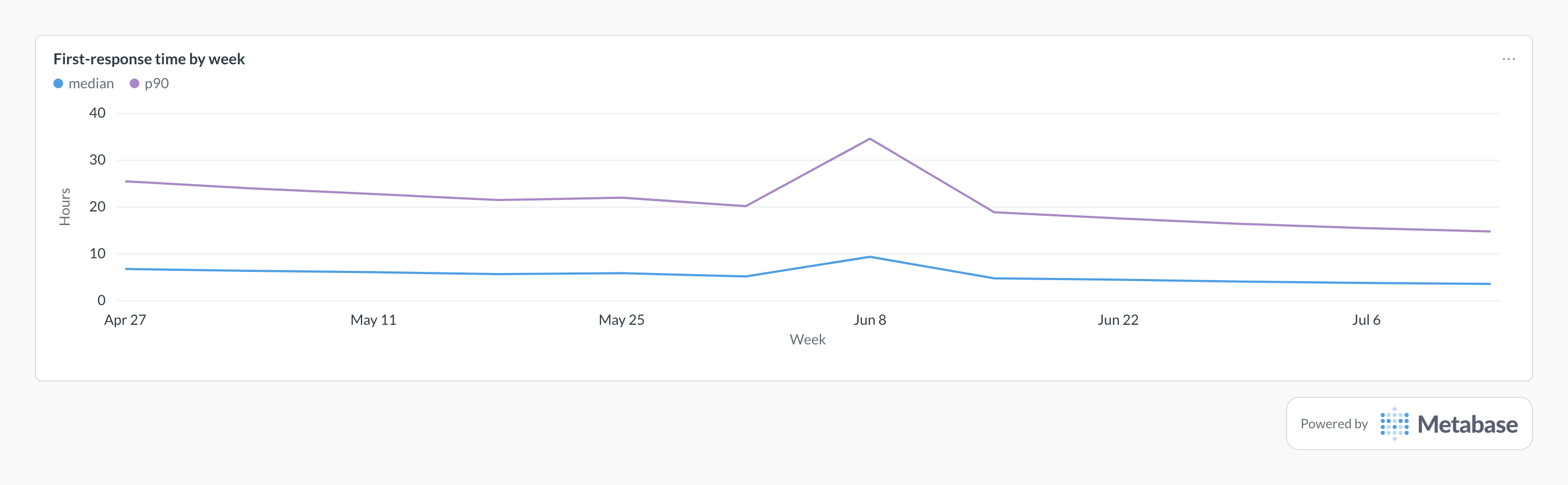
Plot median and p90 first-response hours per week and read the gap between them as well as the slope: both falling means handoffs are genuinely getting faster, not just the easy threads. A spike like Jun 8's, where both lines jump together, usually maps to a thin week — an offsite or holiday — rather than a process regression.
Definition
Define which thread types need a response and what counts as useful. For support or incident channels that may be any non-bot reply; for design reviews it may be the first reviewer comment or resolution action.
Data needed
- Thread/request ID and creation timestamp
- Reply timestamps, authors, and parent relationships
- Bot, self-reply, deleted, and system-message flags
- Workspace, channel, team, request type, and business-hours calendar
SQL pattern
SELECT
  date_trunc('week', thread_created_at) AS week,
  percentile_cont(0.5) WITHIN GROUP (
    ORDER BY EXTRACT(EPOCH FROM (first_useful_reply_at - thread_created_at)) / 3600.0
  ) AS median_response_hours,
  percentile_cont(0.9) WITHIN GROUP (
    ORDER BY EXTRACT(EPOCH FROM (first_useful_reply_at - thread_created_at)) / 3600.0
  ) AS p90_response_hours
FROM collaboration_threads
WHERE first_useful_reply_at IS NOT NULL
  AND is_automated = FALSE
GROUP BY 1
ORDER BY 1;