6 min read
TL;DR
We’ve shipped a bunch of new stuff since the start of the year: Metabot! MCP! Metabot in Slack! Data Studio! AI SQL and Python generation! Dashboards as code!
All that stuff is cool, but it’s the tip of the iceberg.
What we really care about delivering: AI that answers correctly. AI-written code that you can inspect and verify. AI that’s accessible to everyone, but with controls so each person gets appropriate access. Limits and tools to keep it in check. Auditing tools to keep an eye on what’s actually happening. In short, we want you to use AI in your data workflows, with confidence.
AI in your work is nearly as inevitable as death and taxes. Natural language querying is now standard. Chart and dashboard creation is now trivial. However, the plumbing that makes it trustworthy and reliable is both harder and essential for making AI work.
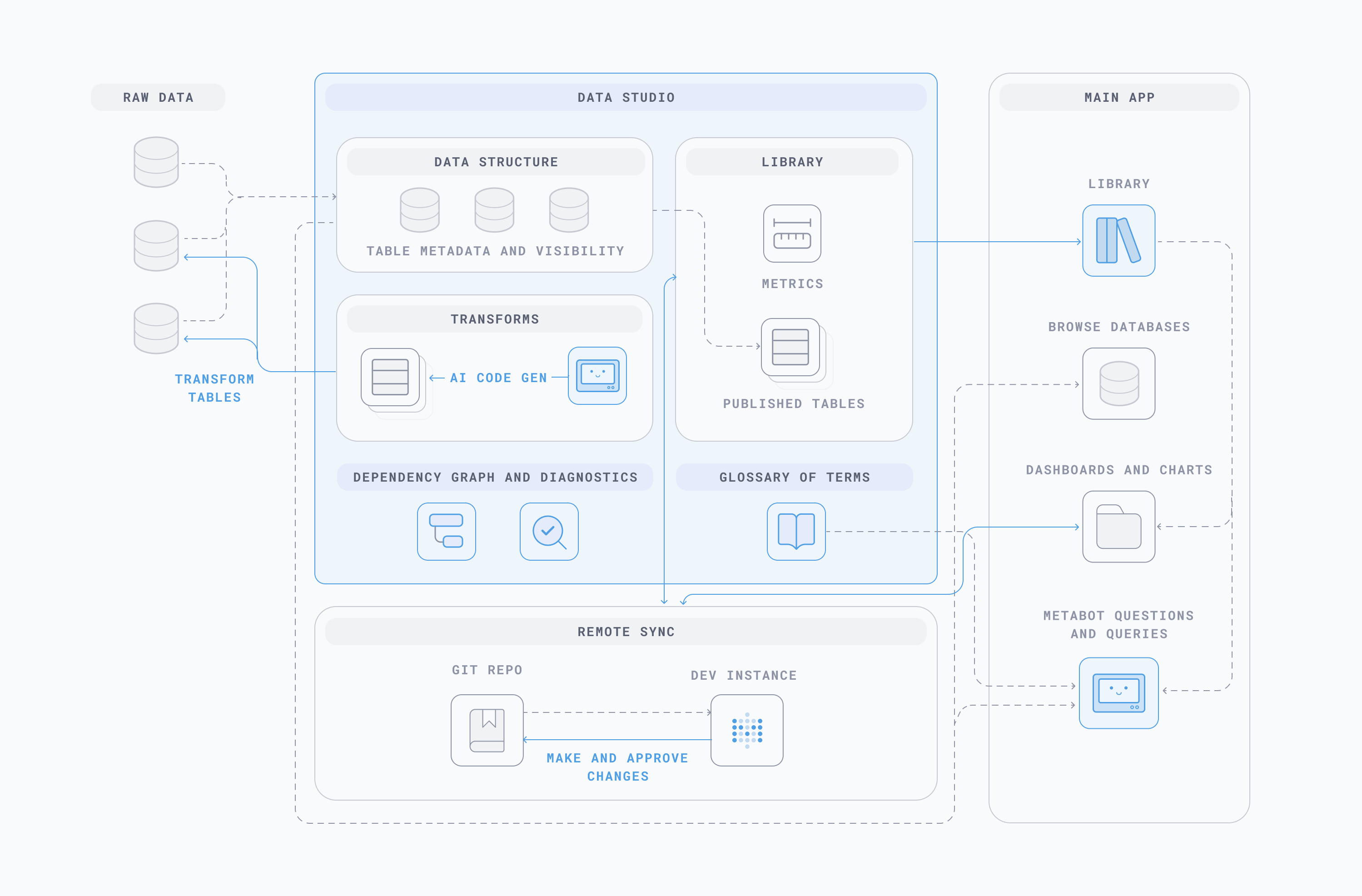
Agents need structure and context to answer questions correctly. Data Studio is where you manage your semantic layer so that AI produces trustworthy answers. It shouldn’t be up to the LLM to decide which of three Accounts tables is canonical, make sense of field names like rev_1234 vs. earnings-q3-445, or define how your company calculates MRR. Those decisions belong in the hands of your data team; they should be made once and applied wherever AI and humans interact with your data.
Data Studio is a dedicated space for defining logic and shaping context that keeps your data team in control of what AI uses and how it answers. Transform data with SQL or Python (Metabot can help write and debug your transform code, ready for you to check). Publish tables to the Library to signal to Metabot and your end-users which tables are canonical. Centralize logic, metrics, and definitions so all answers pull from the same source of truth. Build the foundation for your analytics so LLMs and end-users can get trustworthy answers — without having to guess or trust their gut (or whatever the robot equivalent is).
The dependency graph and diagnostics let you and the LLM verify the integrity of your semantic layer. If a new transform breaks something upstream, you can see it, and resolve it.
When your team wants to ask AI about data, they find a way — with or without you. That means data leaves your environment, AI guesses at how to calculate common aggregations, and you have no way to see how it got there. Most analytics platforms treat AI as a premium upsell. We disagree. AI is a reality of how data work gets done, so we make it available in every edition, including open source. No one needs to leave Metabase to get answers. Data Studio paves the way for AI features to be broadly available as a batteries-included experience: AI that’s guided to the right tables, metrics, and context from the start.
Making AI open source requires infrastructure that lets you decide how it runs — from hosting to powering it on your terms. Since April, you can self-host Metabot and bring your own model, and pay your AI provider directly for tokens. We don’t charge an add-on for AI, and we’re not in the business of selling you tokens. As far as we know, we’re the only analytics platform that works this way. That means you control the model, the cost, and the compliance story end-to-end. For organizations where data legally can’t leave their private networks like government contractors, European orgs under data-sovereignty mandates, and other regulated industries it’s a non-negotiable.
That extends to our MCP server. Building a working MCP server is trivial. Building a reliable one that respects your data access and permissions, and doesn’t break under real usage, is hard. The official MCP, built and maintained by Metabase, is one of the most popular features we’ve launched since the start of the year. And it’s getting better with each release. Now you can use the MCP to create charts and dashboards. And we’re continuing to build on that functionality — check back here in the coming weeks.
AI is all fun and games, until it’s not. Uber spent an entire year of budget in one quarter because all their engineers were unleashed with Claude. In 2024, you didn’t ask your Finance Manager to oversee robot-authored SQL. In 2025, the term tokenmaxxing was still a glint in a tech bro’s eye. Now it’s 2026, and things are getting real — someone needs to be the adult in the room. So we introduced an AI governance layer we endearingly refer to as the Fun Police.
We took AI analytics from accessible-to-everyone to actually-safe-for-grown-up-orgs-with-strict-compliance-needs. Sexy? No. Sensible? Hell yeah. It puts you back in control so the right AI features are put in the right hands. You set token limits to avoid runaway AI bills. You can rely on system prompts and customization options so that Metabot looks and feels like your org, and can answer like a colleague. AI usage analytics gives you full visibility into what’s actually happening, so there are no surprises.
If you’re embedding analytics, the stakes are even higher. You need to be sure of what AI embedded in your product will say, that it won’t leak data across tenants, and that it can’t be manipulated. Those aren’t hypotheticals — they’re the questions we get asked most. So we built the controls into the product: AI that respects your data segregation at the row, column, or database level so your customers or tenants only ever see their own data. AI feature access and token limits you can define per tenant. And audit trails at the tenant and user level, so you know exactly what happened.
Agents will continue to get better at doing the work, and we’ll keep giving you the tools to make the most of AI, with confidence. We want you to manage your Metabase and content without leaving your AI terminal, and to work with your semantic layer and analytics programmatically. The harder, more interesting work is the infrastructure around it: making sure what AI produces is accurate and useful, that it operates within the right perimeter, and that you can see and verify everything it’s done.
That’s what we’ve been building toward. And we’re shipping fast — keep an eye on upcoming releases.
Open a free trial today to start using AI with confidence.