





What is interview pass-through rate, and how do you measure it in Metabase?
Interview pass-through rate is an HR and recruiting metric you can track in Metabase once ATS or HRIS data is synced into a database. Interview pass-through rate measures the share of candidates who advance after an interview stage. It helps teams find stages that are too loose, too strict, or poorly calibrated.
TL;DR — Define the event timestamps and denominator once, report
counts next to rates, and segment only when sample size and privacy rules support
it.
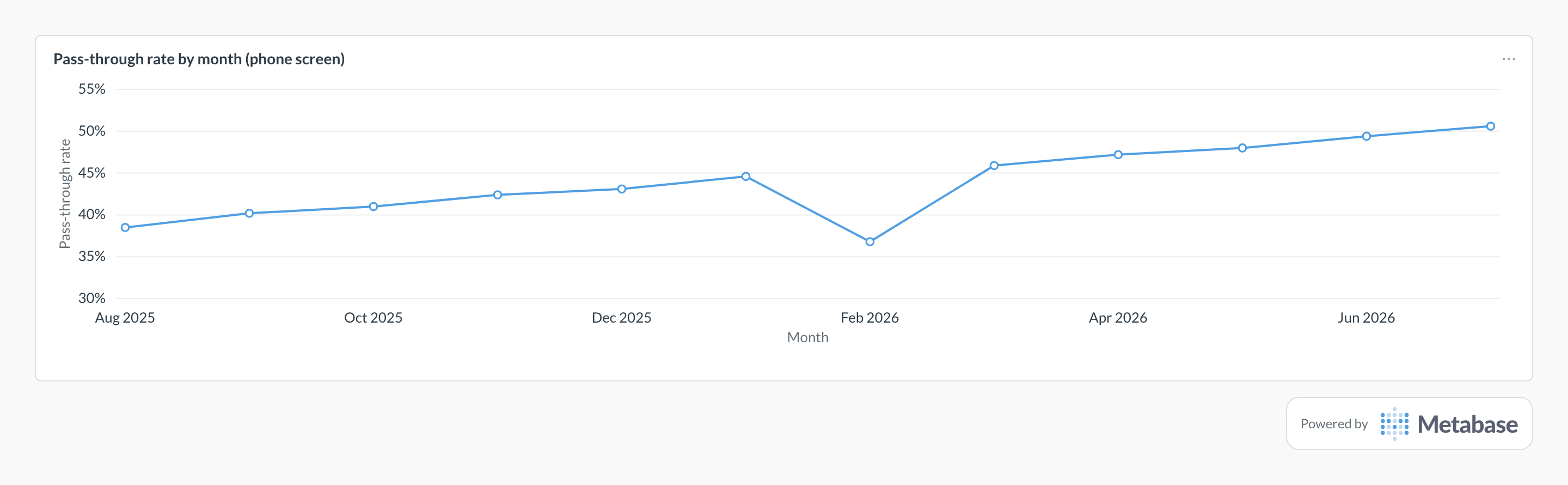
What does an interview pass-through rate chart look like in Metabase?
Trend one stage's pass-through — candidates advancing divided by candidates completing that interview — per month as a line. The gradual climb is what better screening upstream looks like, while a one-month dip like February's often follows a hiring surge that floods the stage; read counts next to the rate before recalibrating interviewers.
How is interview pass-through rate defined?
- Pass-through rate = candidates advancing after an interview stage / candidates completing that interview stage.
- Measure by interview stage, job family, hiring team, and source where sample size supports it.
- Use completed interviews and subsequent stage advancement, not just scorecard recommendation text.
- Track no-shows, cancellations, and missing feedback separately.
What data does it need?
- Interview records with application_id, interview_stage, scheduled_at, completed_at, outcome, and feedback status.
- Stage history showing the next stage or final disposition after the interview.
- Job, department, location, interviewer, recruiter, and source fields for segmentation.
- Candidate withdrawal and rejection reasons so drop-off is not misclassified.
SQL pattern
Interview pass-through rate in Metabase PostgreSQL
WITH completed_interviews AS (
  SELECT
    application_id,
    interview_stage,
    completed_at
  FROM modeled_interviews
  WHERE completed_at IS NOT NULL
), advanced AS (
  SELECT DISTINCT
    i.application_id,
    i.interview_stage
  FROM completed_interviews i
  JOIN modeled_application_stage_history h
    ON h.application_id = i.application_id
   AND h.entered_at > i.completed_at
   AND h.stage_type IN ('later_interview', 'offer', 'hired')
)
SELECT
  i.interview_stage,
  COUNT(DISTINCT i.application_id) AS completed_interviews,
  COUNT(DISTINCT a.application_id) AS advanced_applications,
  ROUND(
    100.0 * COUNT(DISTINCT a.application_id) / NULLIF(COUNT(DISTINCT i.application_id), 0),
    1
  ) AS pass_through_rate_pct
FROM completed_interviews i
LEFT JOIN advanced a
  ON a.application_id = i.application_id
 AND a.interview_stage = i.interview_stage
GROUP BY 1
ORDER BY 1;
Pitfalls
Using scorecard recommendation as advancement. → A recommendation is an input. Advancement is an outcome in stage history.
Ignoring candidate withdrawals. → Withdrawals after interview should be separated from team rejects.
Small sample sizes. → Pass-through rates bounce around when a stage has few candidates. Show
counts next to percentages.
Where this metric applies
Related
Dashboards
Integrations
Metrics
Analytics
FAQ
Is a high pass-through rate always good?
No. It can mean strong sourcing or a stage that is not selective enough. Read it with offer acceptance and later-stage conversion.
Can I compare interviewers?
Be careful. Interview mix, role difficulty, and sample size can mislead. Prefer calibration and process-level trends over individual scoreboards.