





What is workload balance, and how do you measure it in Metabase?
Workload balance shows how open work is distributed across owners, teams, projects, and statuses. It helps managers spot capacity and assignment issues without pretending raw task count equals productivity.
TL;DR — Use workload balance to find bottlenecks, unassigned
work, and overloaded teams. Do not use it as a personal ranking.
What does a workload balance chart look like in Metabase?
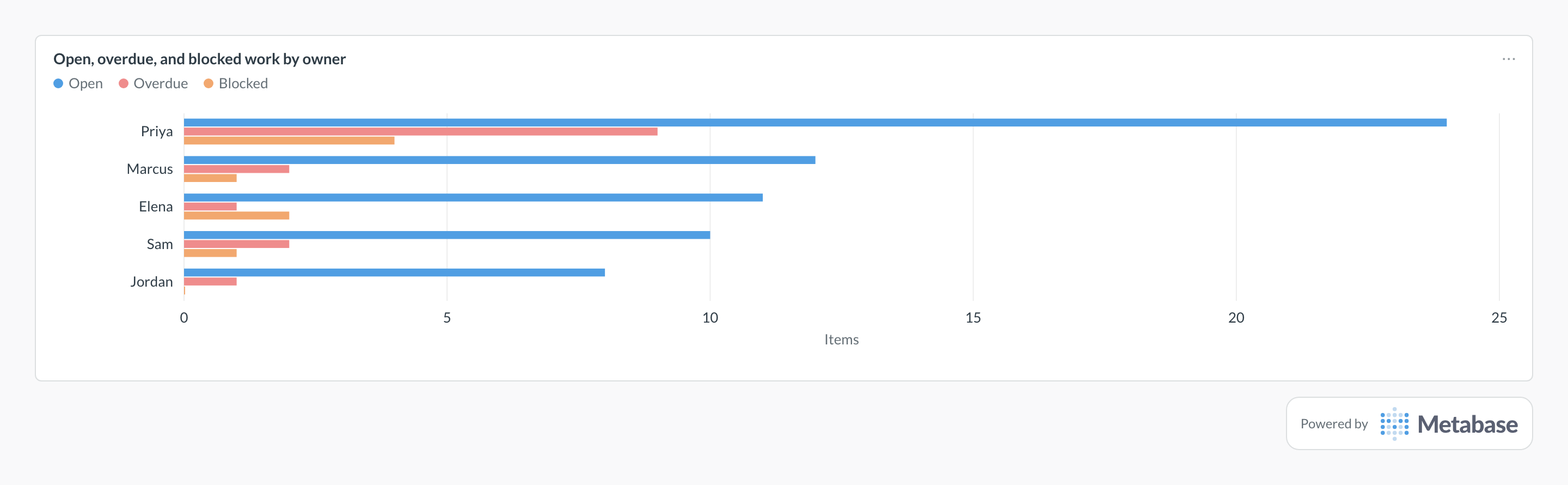
Read this as a distribution, not a leaderboard: open, overdue, and blocked items per owner, heaviest load first. Four owners holding eight to twelve items while one holds 24 — with nine already overdue — is the imbalance the metric exists to surface, and the cue to rebalance assignments rather than to grade anyone's productivity.
Definition
Workload balance is a distribution view, usually open items by owner or team, enriched with overdue and blocked counts.
Data needed
- Owner or assignee
- Status and status group
- Due date and completed date
- Team, project, and work type
SQL pattern
Open, overdue, and blocked work by owner PostgreSQL
SELECT
  owner_name,
  COUNT(*) FILTER (WHERE completed_at IS NULL) AS open_items,
  COUNT(*) FILTER (WHERE completed_at IS NULL AND due_date < CURRENT_DATE) AS overdue_items,
  COUNT(*) FILTER (WHERE completed_at IS NULL AND status_group = 'blocked') AS blocked_items
FROM work_items
WHERE archived_at IS NULL
  AND canceled_at IS NULL
GROUP BY 1
ORDER BY open_items DESC;
Pitfalls
Ranking people by task count. →
Work size, interruptions, and hidden review work make raw counts unfair.
Ignoring unassigned work. →
Unassigned work often explains delivery risk better than owner counts.
Related
FAQ
Should workload be measured by item count or points?
Use item count when sizes are similar. Use points, estimates, or effort bands when work size varies, but keep the caveat that estimates are planning inputs, not objective truth.