





What is average order value, and how do you measure it in Metabase?
Average order value (AOV) is the typical revenue per order. It's one of the three levers of e-commerce revenue — traffic × conversion rate × AOV — and the one you move with bundling, upsells, and free-shipping thresholds. Measure it in Metabase from store data synced into a database (Shopify, WooCommerce, or BigCommerce).
What does an average order value chart look like in Metabase?
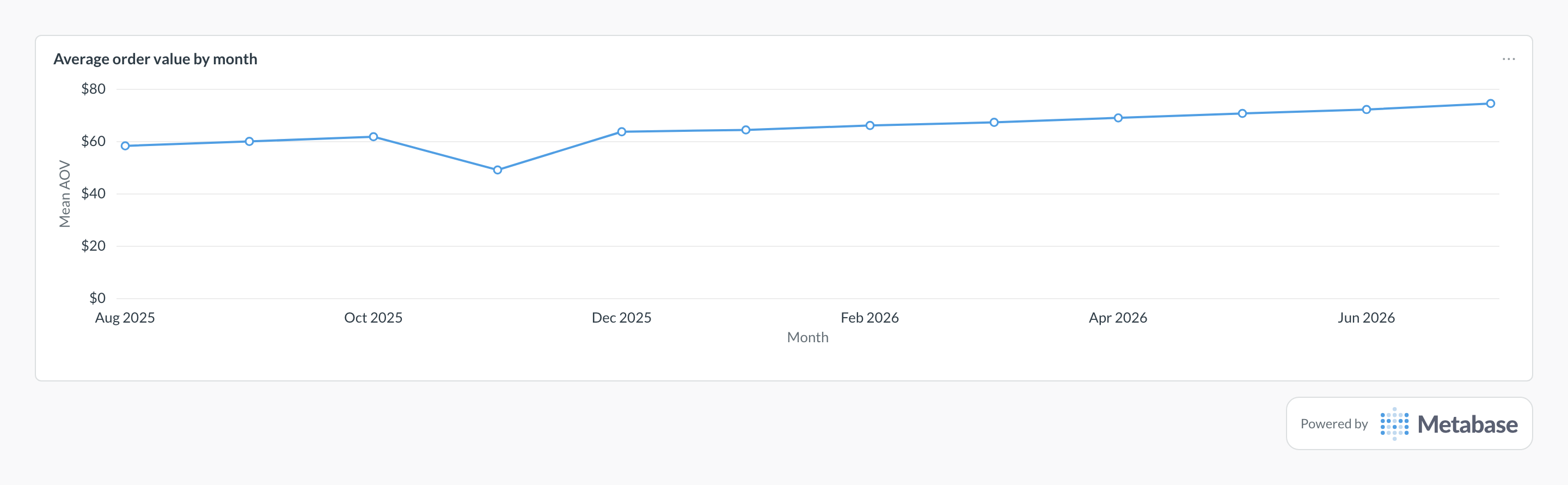
Plot mean order value per month as a line and read the slope: the steady climb from the high $50s into the $70s is bundling and free-shipping thresholds doing their job. A one-month drop like November's usually isn't customers choosing smaller baskets — sitewide discounting pulls every net order total down, so annotate the promo rather than sound an alarm.
How is average order value calculated?
AOV = total revenue over a period ÷ number of orders in that period. The judgment is in "revenue":
- Net of discounts — subtract promo codes and automatic discounts; gross AOV overstates what you actually earn.
- Excluding tax and shipping — usually yes, so AOV reflects product revenue, not pass-through charges.
- Net of refunds — decide whether a refunded order still counts, and be consistent.
What data does AOV need?
-
An orders table with a monetary total and a
created_at. - Discount, tax, shipping, and refund fields so you can define net revenue.
- A financial/payment status to exclude unpaid or cancelled orders.
- Channel or campaign fields for segmentation.
SQL patterns
Net order total averaged monthly, with the median for the skew.
-- Average order value by month, with the median alongside the mean.
SELECT
  date_trunc('month', o.created_at)                       AS month,
  COUNT(*)                                                AS orders,
  ROUND(AVG(o.net_total), 2)                              AS mean_aov,
  ROUND(
    PERCENTILE_CONT(0.5) WITHIN GROUP (ORDER BY o.net_total)::numeric, 2
  )                                                       AS median_order_value
FROM orders o
WHERE o.financial_status = 'paid'
GROUP BY date_trunc('month', o.created_at)
ORDER BY month;Which channels bring bigger baskets over the last 90 days.
-- AOV by acquisition channel to see which traffic buys bigger baskets.
SELECT
  o.channel,
  COUNT(*)                          AS orders,
  ROUND(SUM(o.net_total) / NULLIF(COUNT(*), 0), 2) AS aov
FROM orders o
WHERE o.financial_status = 'paid'
  AND o.created_at >= CURRENT_DATE - INTERVAL '90 days'
GROUP BY o.channel
ORDER BY aov DESC;
Pitfalls
Where this metric applies
- Shopify + Metabase — orders with discounts, tax, and refunds
- WooCommerce + Metabase — order totals and line items in WordPress
- BigCommerce + Metabase — order and transaction data