





What is meetings booked, and how do you measure it in Metabase?
Meetings booked counts the qualified meetings your outbound generates — the clearest leading indicator of pipeline from a sales-engagement motion. It's simple to state but easy to inflate, so the value is in counting it consistently. Measure it in Metabase from engagement data synced into a database (Outreach, Salesloft, Apollo, and others).
What does a meetings booked chart look like in Metabase?
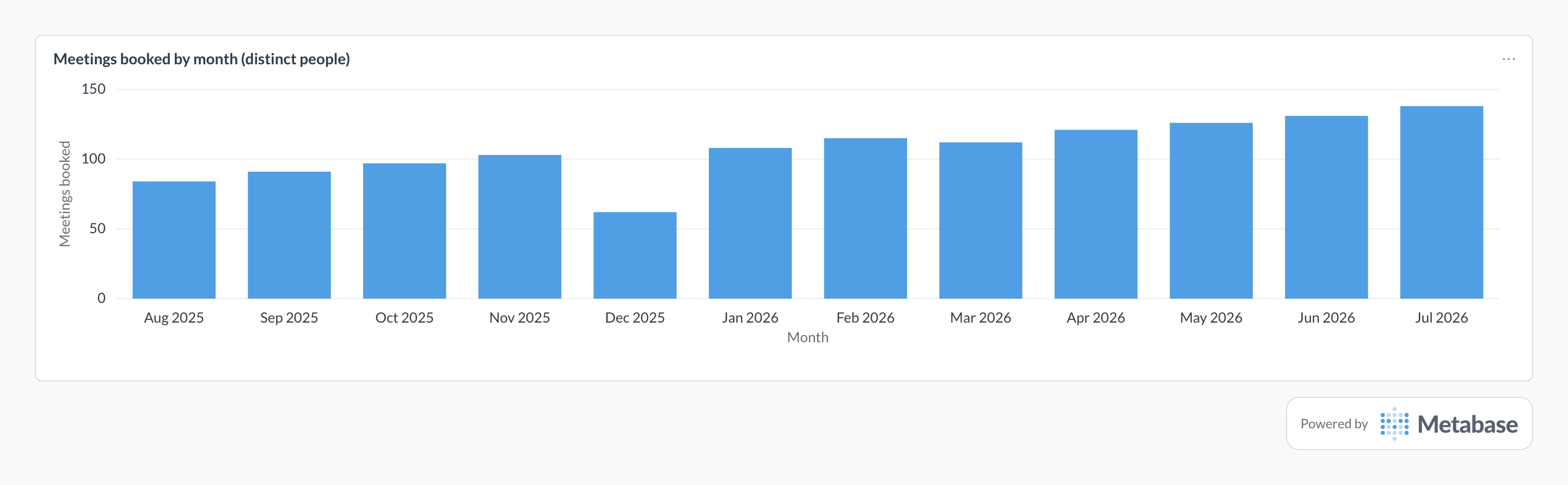
Count distinct people with a booked meeting per month as bars and read momentum across quarters, not single months. The overall climb tracks outbound capacity coming online, while a dip like Dec 2025's is the holiday calendar doing what it always does — worth an annotation, not a pipeline review.
How is meetings booked defined?
The count is simple; the qualifiers are where teams disagree:
- Booked — a meeting was scheduled. Good for measuring outbound activity and momentum.
- Held — the meeting actually happened. Closer to real pipeline, because it excludes no-shows and cancellations.
Both are valid. Report a held rate (held ÷ booked) alongside the raw count so a spike in bookings that never happen doesn't look like success.
What counts as a meeting?
- Decide the unit: distinct prospects with a meeting, or distinct meeting events. Reschedules should not create a second meeting.
- Attribute each meeting to one rep and one sequence so team totals add up.
- Exclude internal meetings and non-sales calendar events with an explicit filter or meeting type.
What data does meetings booked need?
- A meetings table with a
booked_attimestamp. - A status to separate booked, held, canceled, and no-show.
- A person/prospect key and an owner to attribute and de-duplicate.
- Segmentation columns: rep, sequence, segment, and source.
SQL patterns
SELECT
  date_trunc('month', mt.booked_at) AS month,
  COUNT(DISTINCT mt.person_id)      AS meetings_booked
FROM modeled_meetings mt
WHERE mt.booked_at >= CURRENT_DATE - INTERVAL '12 months'
  AND mt.status <> 'canceled'
GROUP BY 1
ORDER BY 1;SELECT
u.name AS rep,
COUNT(*) AS booked,
COUNT(*) FILTER (WHERE mt.status = 'held') AS held,
ROUND(
100.0 * COUNT(*) FILTER (WHERE mt.status = 'held')
/ NULLIF(COUNT(*), 0),
1
) AS held_rate_pct
FROM modeled_meetings mt
JOIN modeled_users u ON u.id = mt.user_id
WHERE mt.booked_at >= CURRENT_DATE - INTERVAL '90 days'
GROUP BY u.name
ORDER BY booked DESC;Pitfalls
Where this metric applies
- Outreach + Metabase — meeting events and outcomes
- Salesloft + Metabase — booked meetings by cadence and rep
- Apollo + Metabase — meetings from sequences
- Mixmax + Metabase — meetings scheduled from Gmail