





What is reply rate, and how do you measure it in Metabase?
Reply rate is the share of contacted prospects who reply to your outbound. It's the headline efficiency metric for a sales-engagement motion — but it's only meaningful once you fix what counts as "contacted" and what counts as a "reply." Measure it in Metabase from engagement data synced into a database (Outreach, Salesloft, Apollo, Mixmax, and others).
What does a reply rate chart look like in Metabase?
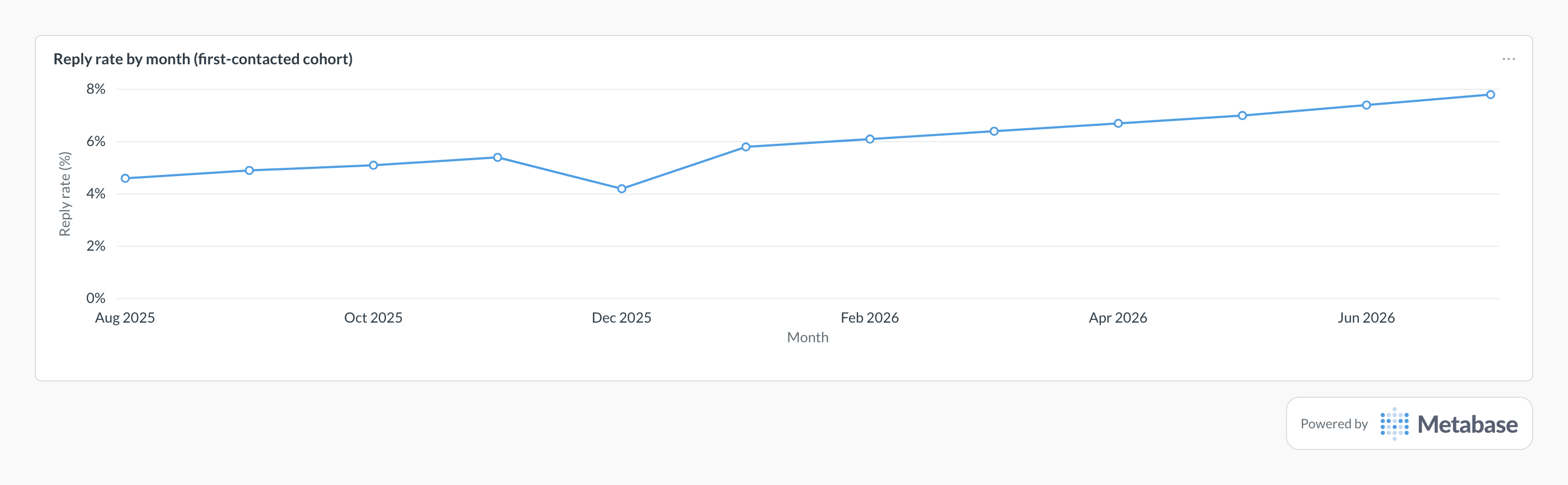
Chart replied over contacted per month, cohorted by first-contacted date, and read the steady climb as targeting and messaging iteration paying off. A dip like December's is the calendar talking — holiday inboxes answer slowly or never — so judge it against last December, not last month.
How is reply rate defined?
The formula is simple; the definitions of numerator and denominator are where teams disagree:
- Replied ÷ contacted (per person) — of the people you reached, how many replied at least once. The most common and most stable.
- Replies ÷ messages sent — of all messages sent, how many drew a reply. Useful for step-level tuning, but sensitive to volume.
Both are valid. What breaks reporting is switching between them, or counting auto-replies as genuine replies.
Choosing and holding a cohort
A reply rate is meaningless without a cohort. Group by first-contacted date (people first reached in the period) and give recent cohorts time to reply before you judge them — a person contacted yesterday hasn't had a chance to respond.
- Positive reply rate answers "how many replies were interested?" — needs reply sentiment or manual tagging.
- Raw reply rate answers "how many replied at all?" — easier to compute, but includes objections and opt-outs.
What data does reply rate need?
- A membership or activity table with a clear first-contacted timestamp.
- A
replied_attimestamp or reply event per person. - A rule for excluding auto-replies and out-of-office from genuine replies.
- Segmentation columns: sequence, rep, segment, and step.
SQL patterns
SELECT
  date_trunc('month', m.first_contacted_at) AS month,
  COUNT(*)                                          AS contacted,
  COUNT(*) FILTER (WHERE m.replied_at IS NOT NULL)  AS replied,
  ROUND(
    100.0 * COUNT(*) FILTER (WHERE m.replied_at IS NOT NULL)
      / NULLIF(COUNT(*), 0),
    2
  ) AS reply_rate_pct
FROM modeled_sequence_memberships m
WHERE m.first_contacted_at >= CURRENT_DATE - INTERVAL '12 months'
GROUP BY 1
ORDER BY 1;SELECT
s.name AS sequence,
COUNT(*) AS contacted,
COUNT(*) FILTER (WHERE m.replied_at IS NOT NULL) AS replied,
ROUND(
100.0 * COUNT(*) FILTER (WHERE m.replied_at IS NOT NULL)
/ NULLIF(COUNT(*), 0),
2
) AS reply_rate_pct
FROM modeled_sequence_memberships m
JOIN modeled_sequences s ON s.id = m.sequence_id
GROUP BY s.name
ORDER BY contacted DESC;Pitfalls
Where this metric applies
- Outreach + Metabase — sequence mailings and reply events
- Salesloft + Metabase — cadence memberships and replies
- Apollo + Metabase — sequences and email events
- Mixmax + Metabase — sequences and message replies