











Stepped out
Cautious About accuracy or control
Curious
Building
Scaling

74% are building. Just 2% are scaling.

How ready is your data team for AI analytics?

Find out where your team stands. Experimenting with AI is easy. Building the data, governance, and workflows to use it with confidence takes more.

5 questions 2 minutes Personalized results

AI readiness quiz

Featured resource

Verified: A framework and action plan for trustworthy AI analytics

AI analytics is only as trustworthy as the foundation underneath it. This framework gives data teams a practical way to move from experimentation toward AI analytics they can confidently scale.

  • A practical framework for trustworthy AI analytics
  • Guidance across data, governance, infrastructure, and people
  • An action plan to move from experimentation to scale

Read the framework

Claude Code skills

Run the same checks in your own Claude Code

Install the Metabase skill set once, then point it at your Metabase to check whether your data and your AI setup are ready.

Add the skills
npx skills add metabase/agent-skills -a claude-code

Requires the skills CLI. Works with Claude Code today.

On-demand demos

See what trustworthy AI analytics looks like in practice

Hear from the Metabase team and see how to make AI analytics useful without giving up trust, control, or the workflows your team already relies on.

  • AI analytics, with receipts

    Pierina Salinas Product Advocate, Metabase

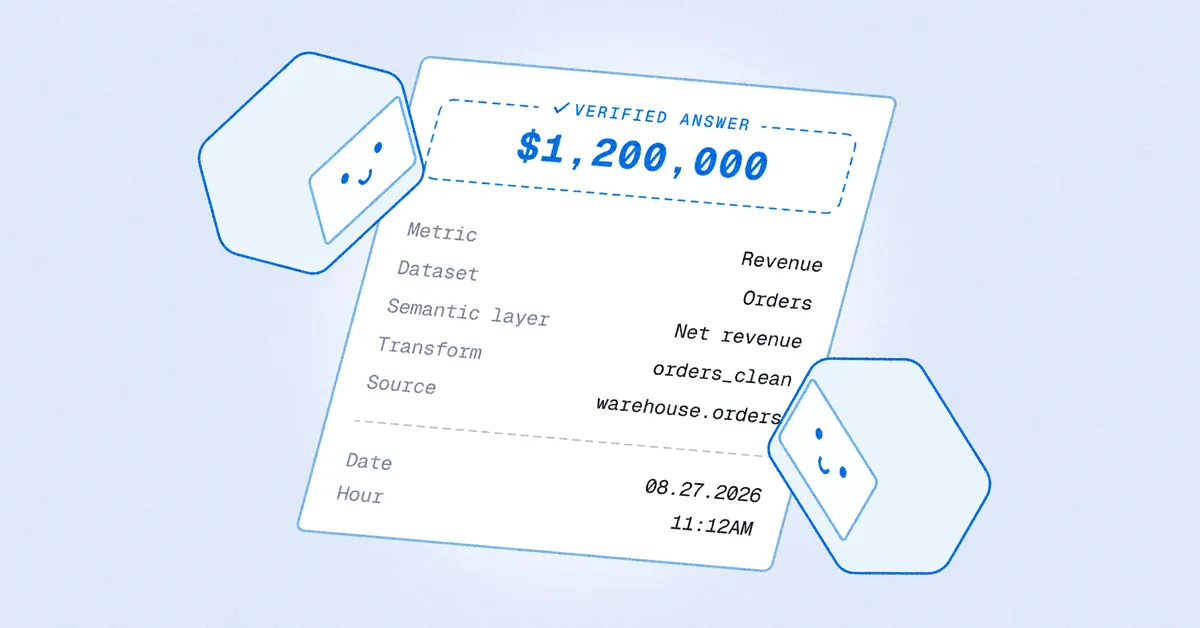
    Getting an answer is easy. Proving it’s right is the hard part. See how a semantic layer gives AI the definitions and context it needs, so your team can inspect the logic behind every answer.

    Watch the semantic layer demo
  • AI on your terms and infrastructure

    Abed Habli Product Advocate, Metabase

    Use AI without giving up control. See how to bring your own models, keep your data in your own infrastructure, and keep the governance, permissions, and audit trails your organization needs.

    Watch the self-hosted AI demo
  • AI analytics, with a build button

    Matthew Hefferon Developer Advocate, Metabase

    Turn a question into a dashboard, explore it with AI, check the SQL, and promote it from dev to prod through a pull request. Dashboards as code, without giving up the GUI.

    Watch the dashboards-as-code demo

Ready to move from experimenting with AI to using it with confidence?

Most teams are building with AI, but few are scaling it. Try Metabase for free and put a governed, verifiable foundation under your AI analytics.

Try Metabase Cloud for free Talk to a person

AI moved the analytics bottleneck from creation to curation.

Actively building with AI

74%

Say they’re scaling

2%

Share of respondents surveyed during Metabase’s AI analytics week.

AI made analytics creation easier than ever. Anyone can now ask a question in plain English and get a chart back in seconds.

The harder question that a lot of teams are still figuring out is: where did that data actually go to produce this answer, and whose servers was it processed on? Right behind it is the second question: how do we know this answer is accurate and not an AI hallucination?

Close to half of respondents surveyed during Metabase’s AI analytics week said their top requirement for an AI analytics tool was the ability to self-host it or bring their own model and keys, specifically so their data never has to touch a third-party vendor’s cloud. In the same survey, 74% said they’re actively building with AI, and only 2% called themselves “scaling,” meaning they’ve moved past experimentation to a governed, repeatable practice.

“Creation used to be the bottleneck in analytics, but now it’s control, guardrails, and verification.”

Why governance is top of mind for teams now

Where does our data actually go, who can see what, can I trust the number, what happens when usage spikes, does it actually understand our business, and can I see what it’s been doing: these are the questions on data leaders’ minds now. None of these are solved by a better model. They’re solved by the same decisions companies have always made about access, data residency, permissions, and accountability, just now moving at the speed of artificial intelligence.

Data governance is not a new problem, but AI makes the stakes much higher. It moves faster, reaches further, and operates with less friction to stop a bad outcome before it happens. For many companies, this shift turned data sovereignty, or the question of where your data lives, who owns the infrastructure, and who and what gets access, from a once-a-year vendor security review into a question that is required every time someone opens a chat window.

TL;DR

Almost everyone is in motion with AI analytics, but the trust problem is largely still open for most teams. This gap is about data sovereignty, not just who’s using the tool. Because adoption is happening faster than governance can keep up, we developed this framework to help you navigate the decisions that determine whether AI analytics can actually be trusted at all — and at scale.

Getting started: Six governance questions to ask now

Begin by understanding what matters most today. Treat these questions as a checklist for any AI-analytics rollout, regardless of which tool you use.

  1. Who gets access to AI analytics?

    Access to AI analytics shouldn’t be a feature toggle you flip for everyone by default. It’s a governance decision, the same as any other access to company data, determined by team, by role, or by use case, and revisited as usage grows.

    Good looks like

    Access assigned to defined groups, reviewed on a cadence, not “everyone with a login.”

  2. Where does the data live, and who controls it?

    When AI touches your data, does that data ever leave infrastructure you control? For a lot of teams this used to be a background assumption. Now roughly half of our surveyed respondents named this their top requirement, specifically asking for the ability to self-host or bring their own model and API keys so nothing has to leave their own environment.

    Good looks like

    You have a real choice. You can self-host and bring your own API key to choose which AI model you use when you need to ensure nothing leaves your servers. You can air-gap for a fully offline deployment. Or you can opt for a managed cloud service where that’s the right tradeoff.

  3. What can AI see?

    Separate from where the data lives is who’s allowed to see it once AI is asking the questions. Risk goes beyond AI generating wrong answers — it can also be AI surfacing an answer from data someone should not be able to see.

    Good looks like

    AI strictly inherits the existing role-based permissions the person already has, with no parallel permissions or access model to build or maintain.

  4. What happens as usage grows?

    AI is cheap when five people are using it, and expensive fast once fifty are burning tokens in unison. Cost control isn’t optional at scale because it’s the difference between a rollout and a runaway bill.

    Good looks like

    Usage limits and alerts set per team, visible before the invoice. Keep token spend in check with limits across the platform, per team and/or per person.

  5. Does AI understand your business?

    Every company has its own shorthand: what “ARR,” “active,” or “big customer” actually means internally. AI that doesn’t know your definitions doesn’t fail loudly; it gives a confident, wrong answer that sounds right.

    Good looks like

    Your key terms, metrics, and preferred data sources are defined and documented where AI can pull from them, so answers are guided by context to correctness.

  6. Can you see how AI is being used and what it’s doing?

    Once AI is part of how people get answers, you need the same visibility into that activity that you’d want into any other system producing numbers people act on.

    Good looks like

    Usage analytics and audit logs as a queryable record of who asked what, which tools were used, what data was referenced, what ran, and what it cost.

The five layers of business context

Now that you’ve set the stage by considering the six questions, it’s time to consider if AI understands your business. These are the guardrails that guide AI to correct answers, and it’s currently the most underinvested area of AI analytics:

  1. Canonical tables and datasets

    Make the starting point for questions clear for AI by being explicit about which tables it should use, without having to guess which of the three “Customers” tables is the right choice.

  2. Metadata

    Descriptions on your tables and fields, written by someone who understands the data, not inferred by the AI. This is the foundation. Without it, AI is guessing at what a column represents.

  3. Metrics

    Define and save aggregation logic as a metric once, so calculations like ARR are computed the same way wherever they’re queried, by whoever’s asking.

  4. Glossary

    Your company’s internal definitions: what counts as a “big” customer, an “active” user, how revenue is calculated. These are the terms that mean something different in every company, and AI needs them spelled out so it never has to infer or make assumptions.

  5. System prompts

    Standing instructions for how AI should behave: how to answer, what to default to, what to never guess at. This is where you encode judgment calls once so they don’t have to be re-litigated in every conversation.

Get these layers right and reduce your fear of “wrong answers.”

Skip them, and no amount of access control or data sovereignty fixes the fact that AI is confidently answering questions it doesn’t understand.

Treat AI-generated content like code

The teams furthest along on the analytics-with-AI journey share one habit: they don’t let AI push directly to production. Anything AI builds, from a dashboard to a metric or a report, goes through the same discipline as a code change: a development environment to build and test in, a review step before it ships, and a record of what changed and why.

This matters more as AI gets faster. The easier it is to generate a new dashboard, the easier it is to generate five wrong ones before anyone notices — unless there’s a checkpoint between “AI built this” and “a stakeholder is looking at this.” It’s the essential step that guards against misinformation and endless AI slop proliferating in your organization.

“I’ve always believed in constructive laziness: do the hard work once so you don’t make smart people solve the same problem over and over again. AI should finally make that possible for analytics. The goal isn’t to use AI to crank out ten times more dashboards or automate the same ticket queue we’ve spent twenty years pretending is ‘self-service BI.’

The promise of AI is to let the data team move up a level: define what the numbers mean, curate the data and context, put the right permissions and guardrails in place, make the work inspectable, and then get out of the way.

Because if AI makes analytics creation nearly free, the scarce thing isn’t another chart. It’s having a system where people and agents can get answers without inventing ten different versions of the truth.

The best data teams won’t be the ones answering the most questions, but the ones who’ve built things well enough that they don’t have to.”

The scorecard

Now that you understand the tough questions around governance, and have considered the layers required to enable trustworthy AI analytics, evaluate your organization with points (1, 2, or 3) on each question below, then total your points to see where you stand.

Who has access to data for AI analytics?

Data sovereignty and control

Visibility

Cost control

Business context

Auditability

Your answers

Action plan

Exploring

AI has more access, and your data may be traveling further, than you’ve consciously decided. Start with access and ask where the data actually goes. Do not start by writing an enormous AI governance policy. Your goal is to reduce the unknowns.

Your next 30 days

Week 1

Map the system.

Document every AI tool currently capable of interacting with company data. Answer the following: Who has access? What data can it reach? Which model/provider processes requests? What information leaves your infrastructure?

Weeks 2–3

Narrow the pilot and test permissions.

Choose one or two groups with a concrete use case. Remove blanket AI access where it isn’t needed. Use representative test accounts to confirm that AI cannot retrieve information outside each user’s authorized scope.

Week 4

Establish your first ten definitions and build your glossary.

Document the ten business terms or metrics your pilot group asks about most.

metabase.com/glossary (opens in a new tab)

By the end of the month, you should have:

An AI/data-flow inventory

Defined pilot groups

A permissions test

A minimum viable business glossary

Action plan

Building

You’re making deliberate decisions, but one or two layers are still carrying significant risk. The usual trap here is buying more AI capability before fixing the context, observability, or sovereignty underneath it.

Your next 30 days

1

Find your lowest two scores in the scorecard.

Ignore the dimensions where you’re already strong, and focus on the areas that need improvement.

2

Turn business context into infrastructure.

Use a semantic layer to create canonical definitions for your highest-impact metrics and add descriptions to your highest-use data sources.

3

Establish cost baselines.

Measure AI usage by team or tenant and decide what should happen when usage exceeds expectations.

4

Start auditing behavior.

Review real questions people ask AI. Those prompts are a roadmap to missing metadata, missing definitions, poor UX, and unmet analytics needs.

5

Assign owners.

Every governance dimension should have a human owner even if the enforcement itself is automated.

By the end of the month, you should have:

Canonical definitions for high-value metrics

Usage baselines

Explicit limits or thresholds

Regular AI usage review

Named owners

Action plan

Governing

Your AI analytics foundation is solid; the remaining gap is more about process than permissions. You know what AI can see and where it runs. Now make sure speed can’t bypass the standards you created.

Next 30 days

1

Separate development from production for persistent analytics.

AI should be able to experiment without instantly changing what the business relies on.

2

Create a review gate.

Decide which AI-generated assets require human review before production.

3

Add dependency checking.

Before changing shared metrics, transforms, or semantic-layer objects, inspect downstream impact.

4

Version high-value analytics.

Put important production content into a workflow where changes are attributable and reversible.

5

Run one governance fire drill.

Pick a hypothetical problem:

Incident 01

An incorrect AI-generated metric reached a board dashboard

Incident 02

A restricted user retrieved sensitive data

Incident 03

AI spend doubled or tripled

Incident 04

A model/provider became unacceptable overnight

Could you identify what happened and contain it quickly?

By the end of the month, you should have:

A dev-to-production path

A human review gate

Dependency checks

Version history for critical analytics

An incident playbook

Action plan

Scaling

Your AI analytics are fundamentally sound. Things are well governed, audited, understood. The next challenge is to apply this same discipline as AI moves into more surfaces, more teams, more agents, and potentially your customer-facing product. The danger at this stage is creating one governed AI environment while new ungoverned ones appear around it.

Next 90 days

1

Review every new AI interface

against the same six questions above, including:

  • In-product AI
  • MCP clients
  • Coding agents
  • Slack or collaboration interfaces
  • Embedded customer analytics
  • New model providers

2

Measure outcomes, not adoption alone,

because more AI usage is not automatically a success. Track whether AI reduces analyst backlog, increases self-service, speeds decisions, or improves customer experience without increasing incidents or distrust.

3

Turn recurring human review into system design.

If reviewers keep catching the same class of mistake, don’t just tell them to keep reviewing it. Ask what semantic definition, permission, system instruction, test, or product constraint could prevent it upstream.

4

Re-score quarterly.

Your architecture, providers, users, agents, and data will change. Governance is not a launch checklist. It’s maintenance.

Data governance used to be a checkbox, and now it’s the starting point.

AI analytics doesn’t require compromising on security, privacy, or control — but it does require answering important questions, and the sooner the better.

If you want to try Metabase (opens in a new tab), you can bring your own model, including open-weight options. You can host it yourself, and no data has to go to a third-party model provider unless you choose to send it there.

Our isolated workspaces will allow agents to work autonomously against your production warehouse without running amok — sandboxed, with changes reviewed before they touch production.

Because every prompt is exposure: when you send a request to a hosted LLM, it’s not just your underlying data that the model sees, it’s the prompt itself, logged and retained on that provider’s terms, not yours.

The time is now. Work through the six questions. Fix the areas where your score is lowest. Give each one an owner. Then re-score in a quarter. The goal is to make AI trustworthy for your analytics. (opens in a new tab)

18 min total

1 / 11

Get started with Metabase Try Metabase Cloud for free