

A medallion architecture organizes the data in a data lake or data lakehouse into successive layers of increasing refinement, conventionally named bronze, silver, and gold. Data lands raw, gets cleaned, and ends up shaped for consumption — each layer built from the one before it.
Worth saying plainly: this is a naming and layering convention, not a technology. The term was popularized by Databricks, but there’s nothing to install and nothing proprietary about the idea — data teams were staging raw data, cleaning it, and publishing curated tables long before the layers had medal names. The convention’s value is that everyone on the team means the same thing by “that’s a silver table.”
The three layers
- Bronze holds data as it arrived from source systems — unmodified, append-only, often semi-structured (JSON event payloads, exported CSVs, change data capture streams). Nothing is fixed here, deliberately: bronze is the durable record of what the source actually said.
- Silver holds cleaned, standardized data: types corrected, duplicates removed, keys resolved, names made consistent, records from different sources conformed so they can be joined. Silver tables still model the business at the level of individual entities and events.
- Gold holds data shaped for consumption — aggregates, wide reporting tables, or star schemas organized around the questions people actually ask. Gold is what dashboards and downstream apps read.
The ETL jobs between layers form a DAG, and the layering pays off operationally: when transformation logic changes or a bug is found, you rebuild silver and gold from bronze rather than re-extracting from source systems that may no longer have the history.
What the layers buy you
The pattern’s real content is two rules. First, keep the raw data: bronze means no cleaning step is ever irreversible. Second, put a boundary between cleaning and consumption: analysts read tables that someone has deliberately published, not whatever an ingestion job happened to write. That boundary is also where quality checks and data contracts naturally attach.
When it’s ceremony
The failure mode is treating three as sacred. Small teams sometimes route trivial data through three ceremonial hops because the diagram says so; complex pipelines sometimes genuinely need four or five stages and shouldn’t contort to fit the naming. The labels are also imprecise at the edges — teams argue about whether a lightly-joined table is silver or gold, which is a sign the convention is carrying more weight than it can bear. Use the layers where the discipline helps; skip the ritual where it doesn’t.
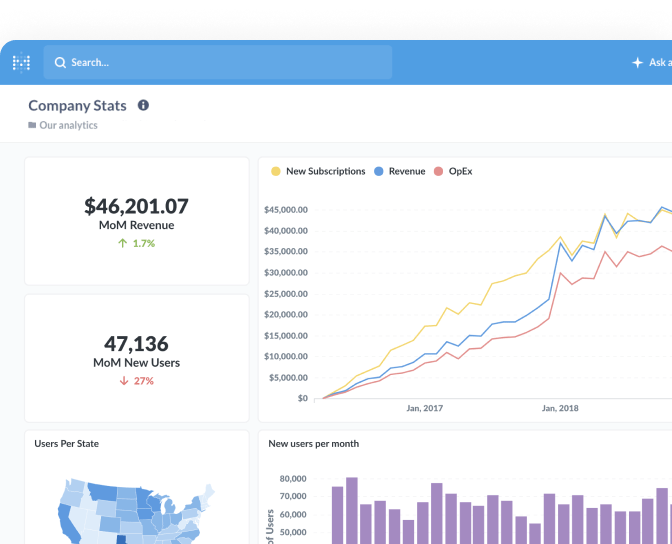
For BI purposes, the practical rule is simple: point people at gold. A tool like Metabase connected to the gold layer gives analysts curated, documented tables — while bronze and silver stay what they are, working layers for the pipeline rather than surfaces for self-serve exploration.
Related terms
Further reading
Put it to work
- Data lake dashboard — Dashboard
- ETL dashboard — Dashboard
- Data freshness — Metric