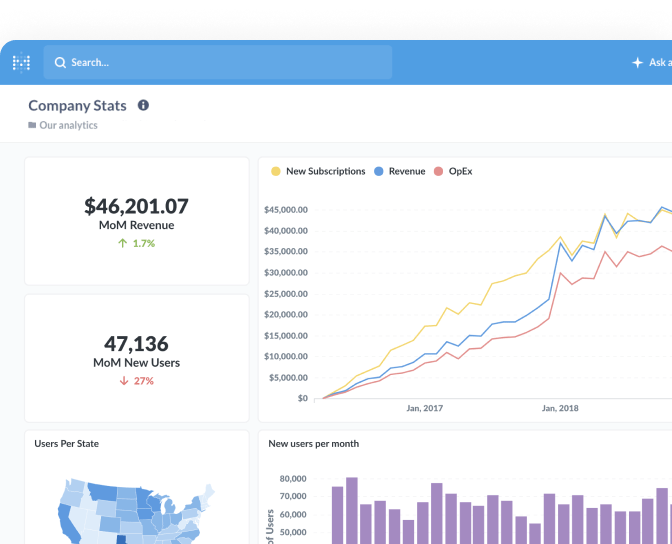


A KPI, or key performance indicator, is a metric that shows progress toward a personal or company goal — and that a team has explicitly agreed to be measured by. Monthly recurring revenue, support ticket resolution time, and deployment frequency are all KPIs for the teams that own them.
KPI vs. metric
Every KPI is a metric, but very few metrics are KPIs. A metric is any number you can compute from your data: page views, average order value, rows inserted per hour. It becomes a key performance indicator only when someone decides that moving it up or down is the point of their work this quarter.
That distinction matters in practice. You can have hundreds of metrics defined in your data model and only four or five KPIs on the wall. Adding a metric costs you a definition; adding a KPI costs you attention, and attention is the scarce thing.
What makes a metric “key”
A metric earns KPI status when it clears a few bars:
- It maps to a goal. If nobody can say what number would count as success, it’s a diagnostic, not a KPI.
- Someone owns it. A KPI with no owner is a number that gets stared at, not moved.
- It’s actionable. The team can plausibly change it with the work they actually do.
- It’s defined once. “Active user” has to mean the same thing in every report, or the KPI turns into an argument about definitions.
- It moves on a useful cadence. A number that only changes annually can’t steer a weekly standup.
Picking KPIs
Start from the goal, not from the data you happen to have. Write down the outcome you want, then ask which single number would most credibly tell you whether you’re getting it. Pair that number with a counter-metric so nobody can win by cheating: cycle time alongside change failure rate, or new signups alongside churn rate.
Different functions land on different KPIs. Finance and revenue teams watch MRR and retention; support watches CSAT and first response time; engineering watches cycle time and deployment frequency. Our metrics library has definitions, formulas, and common pitfalls for each of them.
Tracking KPIs
Put your KPIs where people already look. Define each one once against your data, break it out by the dimensions you actually act on (plan, region, team), and give it a home on a dashboard with the trend visible, not just the current value. A KPI without history is a number; a KPI with history is a signal.
Resist the urge to add more. When a KPI list grows past a handful, teams stop reading it, and the numbers quietly go back to being metrics.
Related terms
Further reading
Put it to work
- MRR — Metric
- Churn rate — Metric
- Cycle time — Metric
- CSAT — Metric