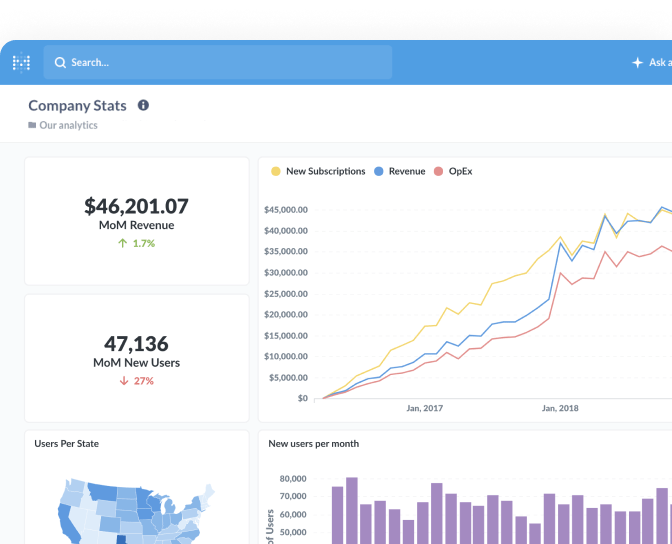


A north star metric is the one number a company or team agrees to steer by. Its job is coordination: when a hundred people are making small decisions every week, a shared north star makes those decisions point the same direction. Classic examples are nights booked for a marketplace, messages sent for a communication tool, or weekly active teams for a collaboration product.
What qualifies
A good north star metric has four properties:
- It measures value delivered, not effort spent. “Songs listened to” is value. “Features shipped” is effort.
- It moves ahead of revenue. If it only goes up after money lands, it’s a scoreboard, not a steering wheel — see leading indicators.
- Teams can actually influence it. If no roadmap decision plausibly moves it this quarter, it won’t change behavior.
- It survives decomposition. You should be able to break it into inputs each team owns — new users × activation × frequency — so that the north star has a real relationship with the KPIs below it.
Common failure modes
Vanity metrics. Registered users, page views, and cumulative totals only go up. A number that cannot fall carries no information; if a bad quarter wouldn’t show up in it, it’s not a north star.
Gameable metrics. Anything a team can move without helping a customer will eventually be moved that way — not usually through bad faith, but because incentives quietly reshape priorities. Sessions per user goes up when the product is confusing. Tickets closed goes up when agents close tickets early.
Revenue as the north star. Revenue is the outcome you want, but it’s lagging, heavily influenced by pricing and sales mix, and gives a product team almost no signal about what to build next week.
Too many north stars. If everything is a north star, nothing is.
One metric or a small set?
One headline metric works well when a company has a single dominant loop. Most larger companies need a small constellation instead — a north star plus three or four inputs, plus explicit guardrail metrics that must not degrade while you push the star up (churn, support load, latency, margin). The guardrails are what stop the north star from being optimized into a bad product.
Whatever you pick, write down the exact definition, the segment it applies to, and who owns it. Undocumented definitions drift, and two teams quietly computing the same north star differently is worse than having none.
Browse the metric guides for candidate definitions and the data each one needs.
Related terms
Put it to work
- All metric guides — Overview
- Activation rate — Metric
- Feature adoption rate — Metric
- Product feedback analytics — Overview