




What is cost per acquisition, and how do you measure it in Metabase?
Cost per acquisition (CPA) is total spend divided by acquisitions — paying customers, or whatever target conversion event a campaign is optimized toward. It's the efficiency metric one rung below CAC and one rung above cost per lead. Measure it in Metabase from spend synced from Google Ads, Meta Ads, and LinkedIn Ads, joined to conversions from your own backend.
spend ÷ acquisitions, blended and per
channel, with conversions counted from your warehouse rather than summed
from platform dashboards. Platforms attribute generously; the same purchase
can show up as a conversion in three of them at once.
What does a CPA chart look like in Metabase?
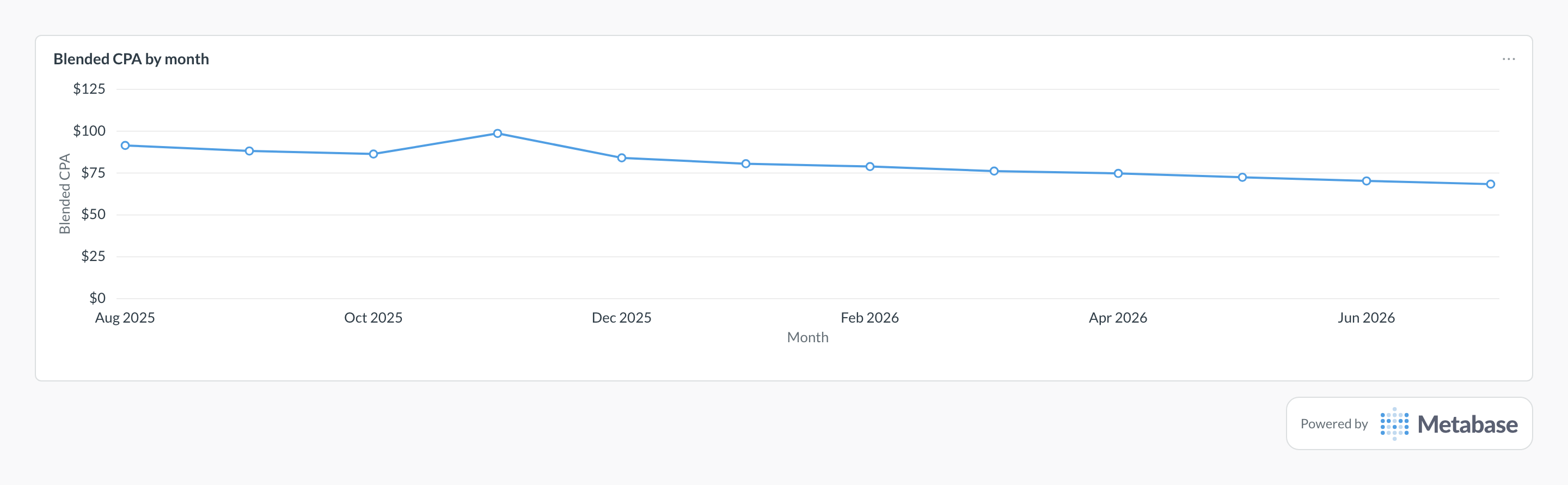
Chart blended CPA by month as a line, and read the slope as the efficiency story: a steady decline means spend is buying acquisitions more cheaply as targeting and channel mix improve. A spike like November's is usually seasonal — Q4 auctions price every advertiser up — and reads next to the calendar, not as a broken funnel.
What cost per acquisition measures
It measures how much media budget it takes to produce one unit of the outcome you actually want — a purchase, a subscription, a funded account. That makes it the natural currency for budget allocation: campaigns and channels compete on CPA against a target derived from what an acquisition is worth. Trended blended CPA also works as an early-warning signal for CAC, because media efficiency usually deteriorates before the fully loaded number does.
CPA vs. CAC
The two get used interchangeably in decks, but they answer different questions. CPA is scoped: this channel's (or this campaign's) media spend over the conversions attributed to it. CAC is fully loaded: all sales and marketing cost — salaries, agencies, tools, spend — over all new customers, attribution-free. CPA tells you where the next dollar of budget should go; CAC tells you whether acquisition is affordable at all. The scoping also means CPA depends on an attribution model while CAC mostly doesn't, so when the two trend in opposite directions, look at attribution first.
What data does it need?
-
An
ad_performance_dailytable withchannel,campaign,stat_date, andspend, as each platform reports it. -
A
conversionstable from your backend or CRM withconverted_at,conversion_type, and attributed channel/campaign fields — deduplicated, one row per real acquisition. -
A written attribution rule (window and priority) applied consistently when
stamping
attributed_channel.
SQL patterns
WITH monthly_spend AS (
  SELECT
    date_trunc('month', stat_date) AS month,
    SUM(spend) AS spend
  FROM ad_performance_daily
  GROUP BY 1
),
monthly_acquisitions AS (
  SELECT
    date_trunc('month', converted_at) AS month,
    COUNT(*) AS acquisitions
  FROM conversions
  WHERE conversion_type = 'purchase'
  GROUP BY 1
)
SELECT
  s.month,
  s.spend,
  a.acquisitions,
  ROUND(s.spend / NULLIF(a.acquisitions, 0), 2) AS blended_cpa
FROM monthly_spend s
LEFT JOIN monthly_acquisitions a USING (month)
WHERE s.month >= date_trunc('month', CURRENT_DATE) - INTERVAL '12 months'
ORDER BY 1;WITH spend AS (
SELECT
channel,
campaign,
SUM(spend) AS spend
FROM ad_performance_daily
WHERE stat_date >= CURRENT_DATE - INTERVAL '90 days'
GROUP BY 1, 2
),
conv AS (
SELECT
attributed_channel AS channel,
attributed_campaign AS campaign,
COUNT(*) AS acquisitions
FROM conversions
WHERE conversion_type = 'purchase'
AND converted_at >= CURRENT_DATE - INTERVAL '90 days'
GROUP BY 1, 2
)
SELECT
s.channel,
s.campaign,
s.spend,
COALESCE(c.acquisitions, 0) AS acquisitions,
ROUND(s.spend / NULLIF(c.acquisitions, 0), 2) AS cpa
FROM spend s
LEFT JOIN conv c USING (channel, campaign)
ORDER BY s.spend DESC;Pitfalls
Where this metric applies
- Google Ads + Metabase — spend and conversion actions by campaign
- Meta Ads + Metabase — spend by campaign against warehouse conversions
- LinkedIn Ads + Metabase — high-CPA B2B campaigns where dedup matters most
- TikTok Ads + Metabase — spend for blended CPA across emerging channels
Related
Metrics
Dashboards
FAQ
CPA vs. CAC — what's the difference?
Why do platform-reported CPAs disagree with our warehouse?
Should I track blended or per-channel CPA?
How do you calculate cost per acquisition?
SUM(spend) / NULLIF(COUNT(acquisitions), 0). The two load-bearing choices are what counts as an acquisition — a paid customer, a subscription start, whatever target event you name — and which attribution window ties a conversion back to spend. Write both down once and apply them identically across channels, otherwise you are comparing definitions. Related: cost per lead prices the step before acquisition, CPC the step before that.