Metabase Data Apps are custom AI apps that run on your data and inherit your permissions. Here’s what we built with them (F1, asteroids, pumpkins) and how it works under the hood.
Metabase has a team called the Product Advocates. Our job is to answer questions from people all over the world about the Metabase platform.
Recently, a couple of us (Andrew and Abed) traveled to Sweden to give people a first look at Metabase Data Apps. We had been invited by our friends at ClickHouse to present at their AI Builders Talk in Stockholm. We came prepared with something a little different: not another dashboard or chart, but fully interactive applications built on top of data in Metabase.
What are Metabase Data apps?
Over the last 10 years, Metabase has crafted an intuitive platform for visualizing data in a collaborative setting. You connect your data sources, create charts and dashboards, and control access to who should see what. Historically, designing intuitive experiences meant anticipating what people sought to accomplish and surfacing good choices. AI has changed this equation. While we previously didn’t want to overwhelm people with a million settings icons for pixel perfect, custom experiences, AI dramatically simplifies the creation and maintenance of complex, tailored solutions. To this end, our engineers built data apps, which allow you to host custom AI-generated applications inside your Metabase built on your data sources and permission structures.
So we got a little unhinged during a company hackathon
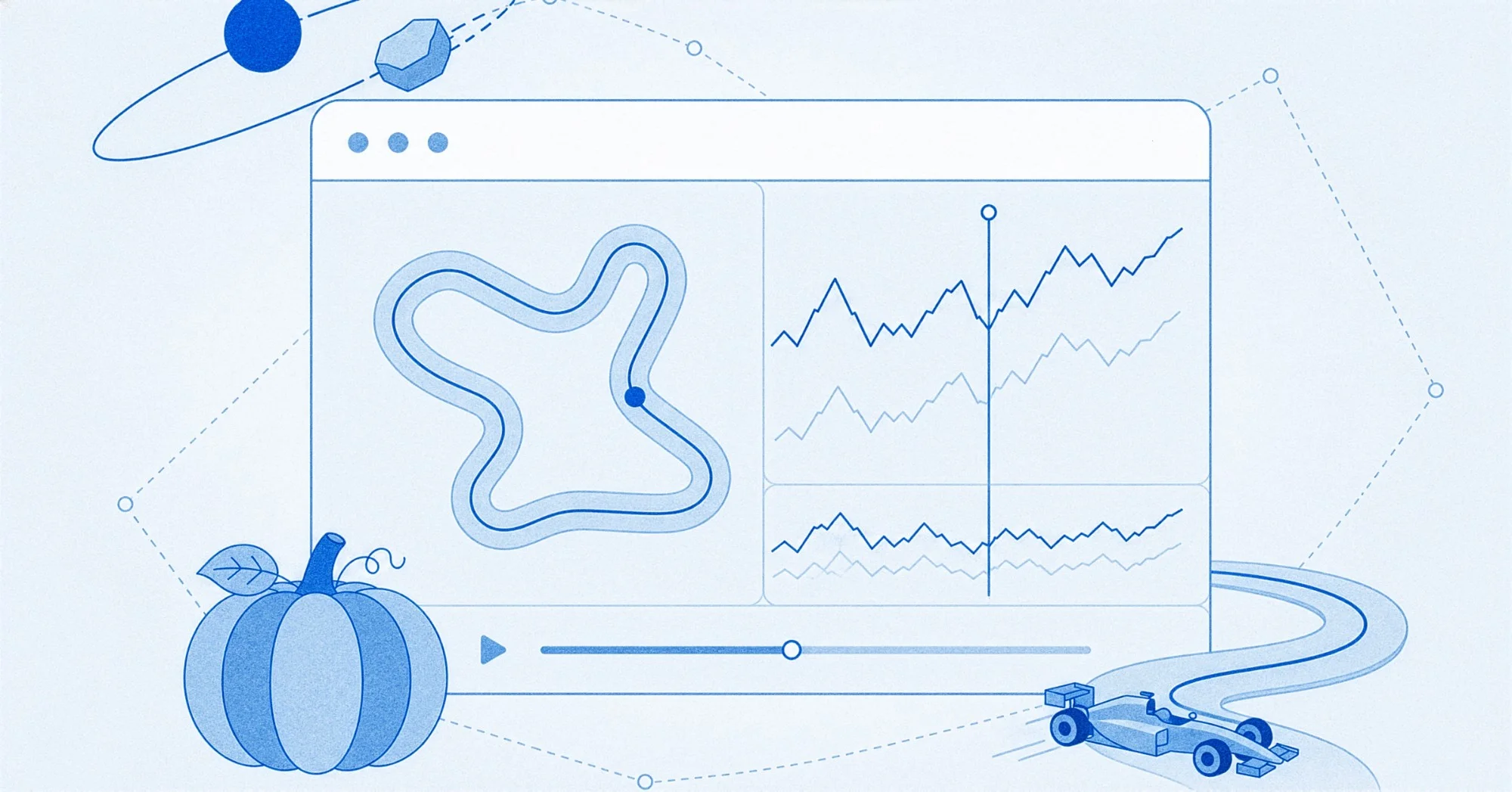
Abed and I knew that we wanted to present the early version of data apps at our October talk. We wanted to show the power of data apps alongside the easy scalability of a ClickHouse database. But we didn’t yet have a knock-your-socks-off demo. Thankfully, every year we have an annual company offsite featuring a hackathon.(This year took place in Toronto. Want in on the next one? We’re hiring.) The hackathon offered the perfect opportunity to drink Red Bull, finagle the help of senior engineers, and generally overthink every aspect of our demo to perfection. We got more than we bargained for. The day before the hackathon, we discovered that Metabase success engineer Juan Tello had a background in astronomy and that fellow Metabase success engineer Marc McElhinney had a background in watching a lot of F1. Using this expertise, we designed two data apps.
Observing asteroids that could kill us all
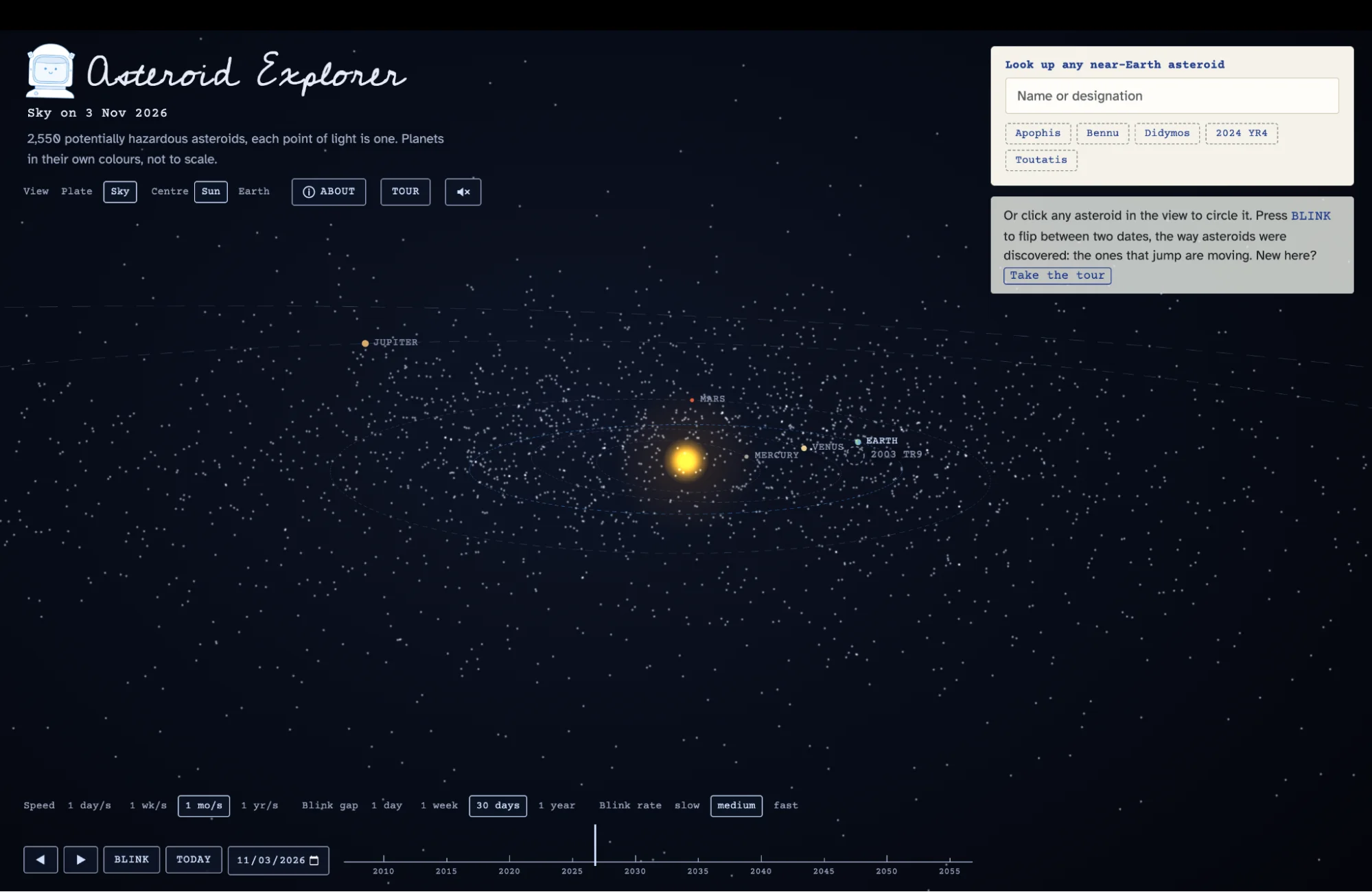
This somewhat terrifying app provides a 3D visualization of asteroids orbiting the sun, including those on trajectories to nearly hit Earth. Apparently, many asteroids have almost hit Earth and many more will almost hit Earth. But, as Juan says, don’t worry, “space is big.” (Tell that to the dinosaurs, Juan.)
We built the app by loading NASA’s asteroid position data into ClickHouse Cloud. To extract the NASA data, we used a nifty ClickHouse feature that lets you create tables from URLs. From there, we created a GitHub repository and used Claude to generate version 1 of our data app idea. We continued iterating on the data app working on different feature branches and merging each new feature when we felt it was ready. This version-controlled workflow allowed us to work simultaneously and make bold, reversible choices.
Replaying F1 races on 60 million rows
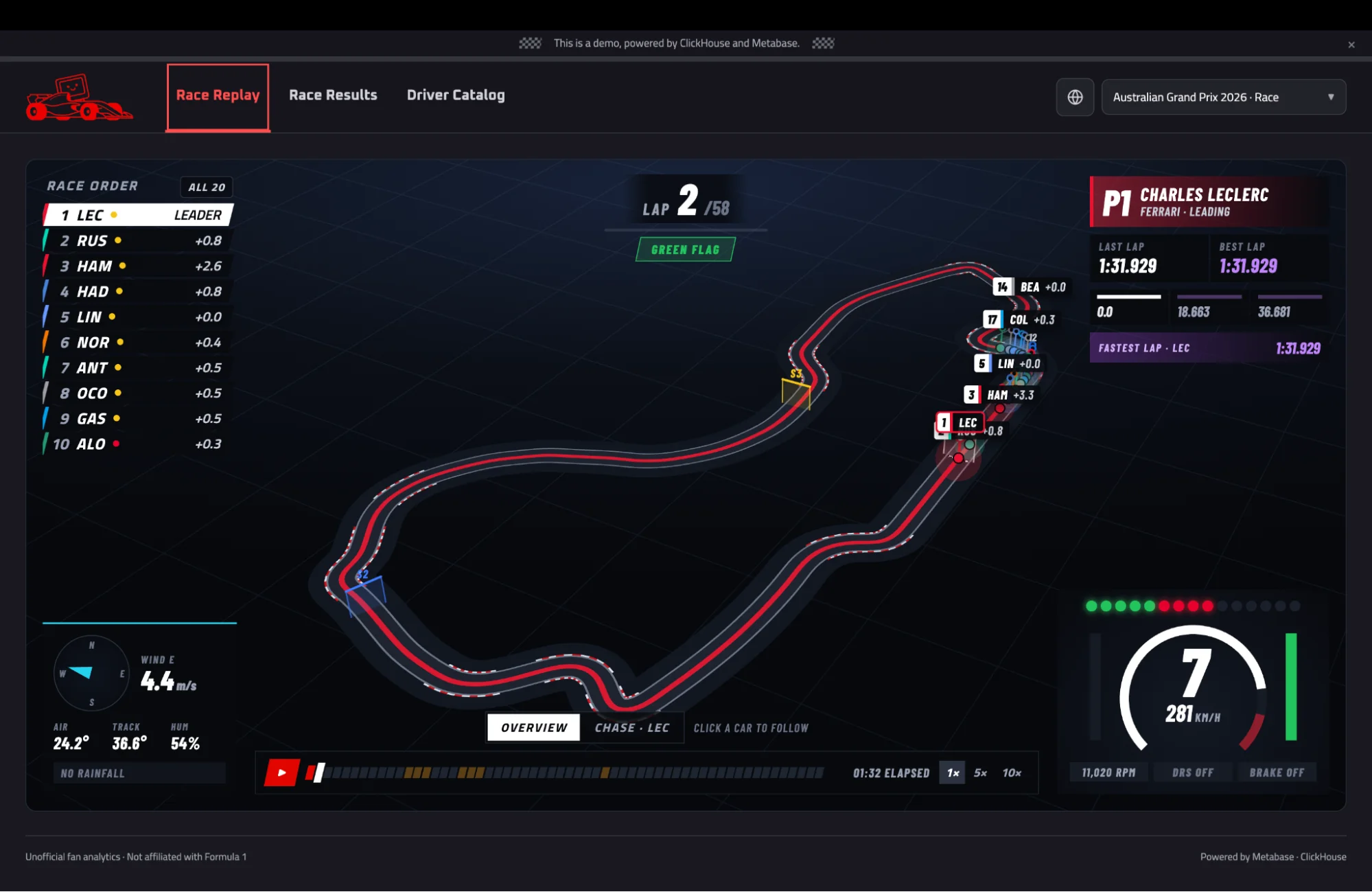
Our asteroid data app used about 30k rows of data. For our second demo, we wanted a much bigger dataset that showcased why data apps pair well with ClickHouse. And so we decided to use F1 telemetry data, which is available as an open-source Python project. The telemetry data includes racing metrics like speed, throttle, gear, track position data, recorded several times per second. We loaded this data using Python scripts, ending up with about 60 million rows.
As we discovered, Andrew knows pretty much nothing about F1 and Abed and Marc know a lot. The combination of ignorance and expertise led us to design a platform that shows fine-grained replay of individual races in a fun UI. Our favorite feature allows you to re-run a driver’s best lap from a given race. You can even observe how their steering wheel gyrates sharply on a track’s hairpin turns.
This level of detail resulted in our app firing off many queries per second. ClickHouse handled this scale remarkably well. Thanks to its columnar storage, ClickHouse heavily compressed the data, so queries could read data quickly. To handle our high volume of queries, ClickHouse Cloud spun up read replicas, which are multiple copies of the database working in parallel. ClickHouse’s Cloud service distributed incoming queries equally between these database copies, ensuring no single one got overwhelmed.
Bonus fall seasonal demo: Metapumpkin
To be honest, we were sure we would win the Metabase hackathon. We expected to be carried out of the room on shoulders. Alas, there were many cool projects that day (damn you Tony Cini!). But the hackathon served its purpose of opening our eyes to the limitless possibilities of data apps and solidified our AI Builders presentation.
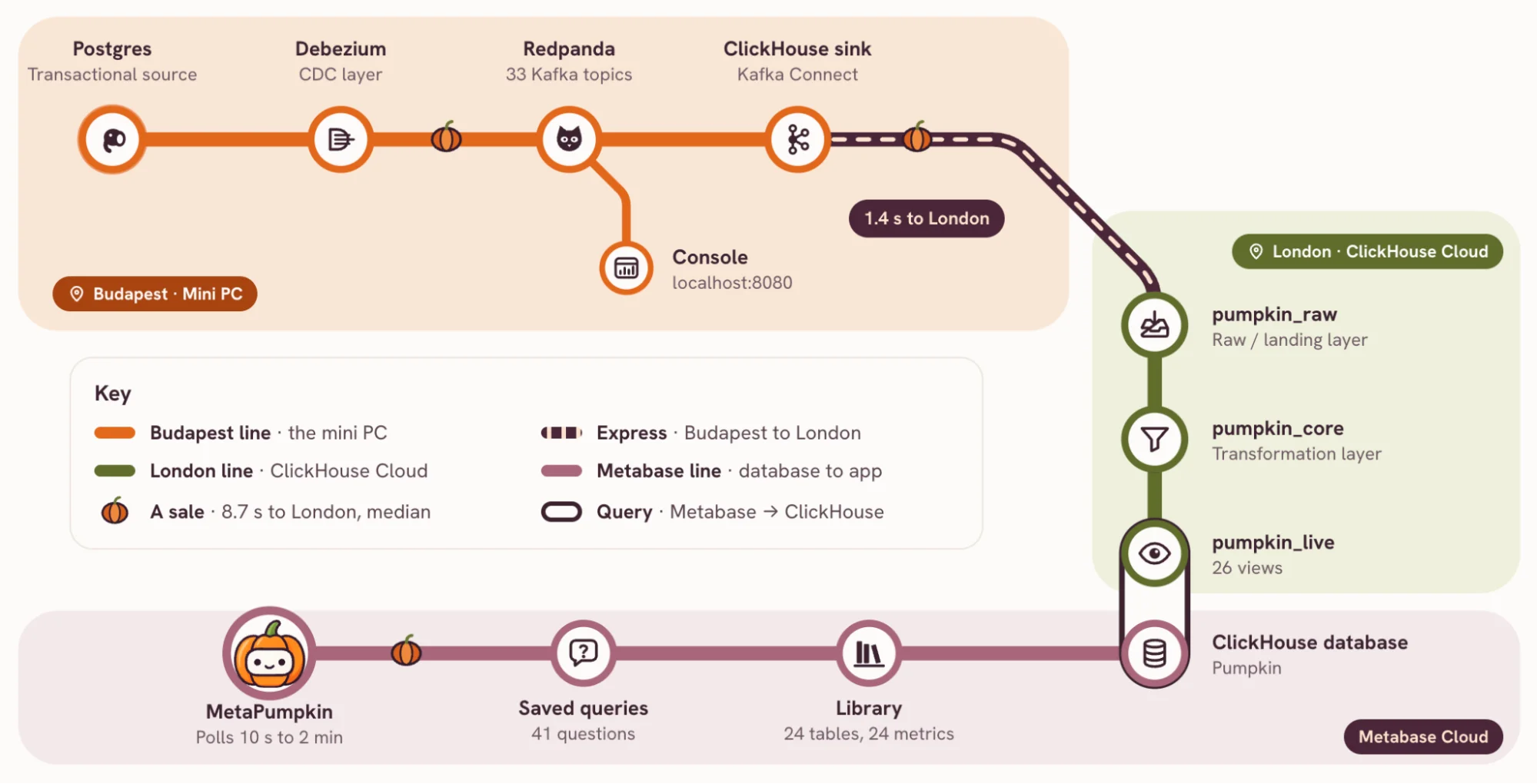
In fact, Abed, so enthralled with the thrill of creation, even took some time the following week to create a third data app, Metapumpkin: an enterprise ERP solution for a successful international network of pumpkin merchants. To illustrate a data flow, Abed configured a mini PC to move data from a production database into ClickHouse via production-grade tools:
Why build data apps in Metabase instead of vibe coding them?
Around 100 people from the Swedish data community joined us for ClickHouse’s event in Stockholm. One of the most interesting questions from the crowd was, “Why should I do this type of AI building with Metabase?” It’s a fair question. There are many ways today to vibe code an application. However, what remains tricky is how you govern access in your AI-built solutions and ensure their reporting accuracy. With Metabase Data Apps, you can assign access to only those who need it. You can set up a row-level security policy to determine who sees which rows of data in the app. And you can easily review all queries sent from the data app, since each data app gets organized as a dedicated collection of questions (i.e. SQL queries) in the Metabase UI.
Beyond controlling access, Metabase also offers a suite of tools to curate the data presented in your apps. Given free rein, AI can generate some wacky SQL. With Metabase’s Data Studio, you can publish reliable metrics and tables for AI to build on. As your data structures evolve over time, you can leverage Data Studio’s dependency management and version control to keep systems running smoothly.
Try data apps yourself
We came away from our trip to Sweden eager to keep building with and talking about data apps (huge thanks to Daniel Madalitso Phiri for organizing the event and inviting us).
Seeing a demo is fun, but building your own is better: Data Apps are available on Metabase Pro v65 and above. The getting-started guide walks you through building your first one. If you’re new to Metabase, you can start a free Cloud trial or chat about your use case with our team of experts.
The bottleneck moved: how to build a semantic layer for AI Analytics
AI removed the querying bottleneck and created a verification one. Here's the semantic layer that makes AI-generated answers traceable, and how to build it.
We've shipped a lot of AI features since the start of 2026. Here's how they fit together, and why the infrastructure around AI matters as much as the features themselves.

 From Toronto Hackathon to Stockholm meetup: Metabase Data App world tour 'Wait, you don't have a semantic layer yet?' AI analytics readiness pulse As humans write less code: workloads shift from human to agent verification with iterative test suites We don't use PHP Making pivot tables faster with GROUPING SETS