




What goes in an AWS monitoring dashboard in Metabase?
An AWS monitoring dashboard puts the health of your EC2 fleet, load balancers, volumes, databases, and caches on one page — built from CloudWatch metric rollups exported to a database, where they can be joined to owners, releases, and spend. CloudWatch keeps the pager; this is the review and reporting layer on top.
For: platform engineers, SREs, and engineering leadership. Grain: one row per resource per hour or day — rollups, never raw datapoints. Refresh: hourly.
What does an AWS monitoring dashboard look like?
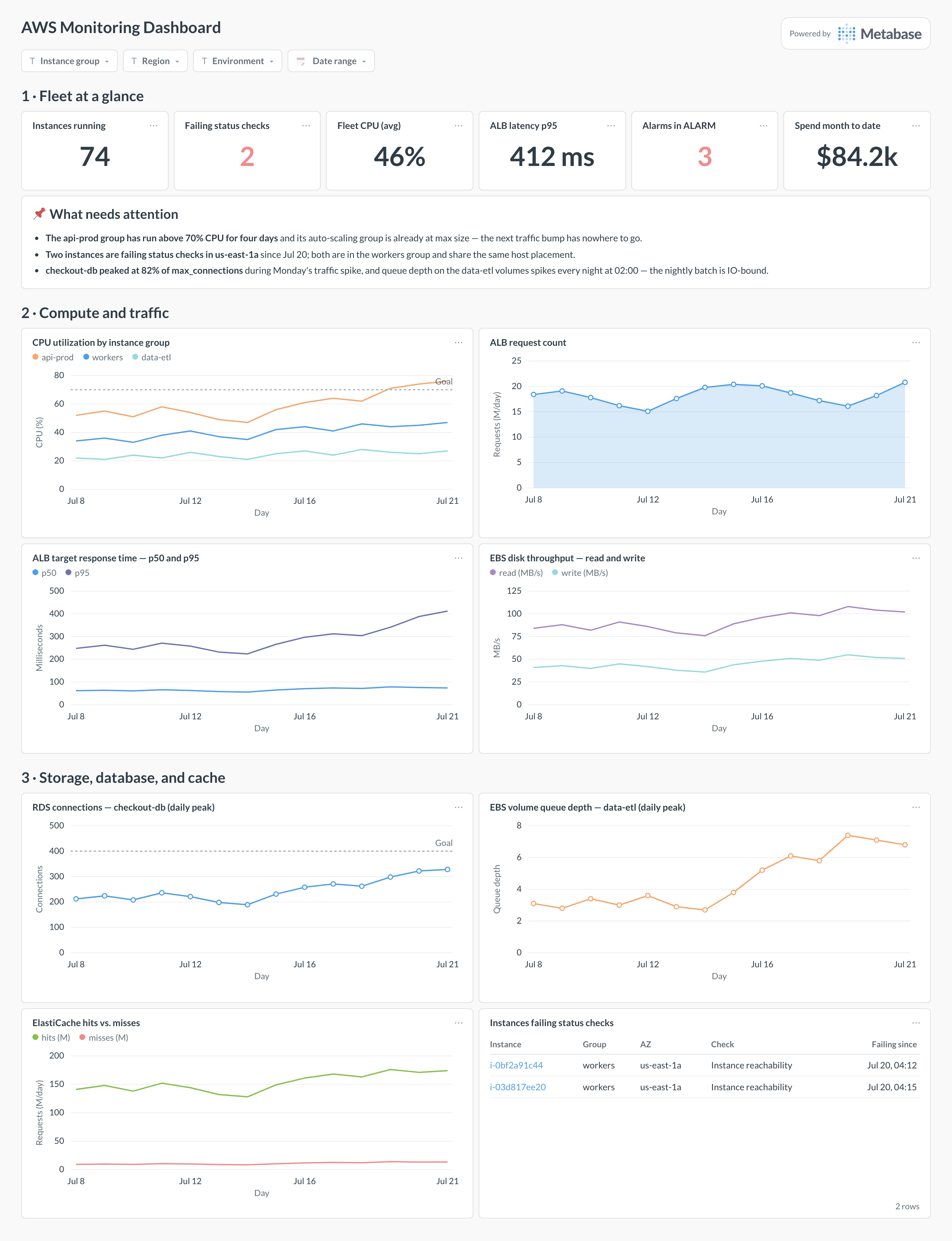
Here’s the layout this guide builds. Fleet-level counts and the two red numbers sit at the top; compute and traffic trends fill the middle; storage, database, and cache detail sits at the bottom with the failing-instances table you drill into when a status check goes red.
Which cards belong on an AWS monitoring dashboard?
The classic eight, modernized from per-instance graphs to per-group ones — at fleet size, groups are what you can actually act on.
- CPU utilization by instance group, against a scaling threshold (line)
- Request count from the load balancer (area)
- Latency — ALB target response time p50 and p95 (line)
- Disk read/write throughput across the fleet’s volumes (line)
- Node status — instances failing status checks (number + table)
- Database connections against
max_connections, per RDS instance (line) - Disk queue depth on the busiest volumes (line)
- Cache hits vs. misses from ElastiCache (line)
What data does the dashboard need?
cloudwatch_metric_rollups— one row per resource, metric, and window: EC2 (CPUUtilization,StatusCheckFailed, disk and network IO), ALB (RequestCount,TargetResponseTimepercentiles), EBS (VolumeQueueLength, throughput), RDS (DatabaseConnections), and ElastiCache (hits and misses).instances— an inventory with instance group, environment, region, AZ, and owner tags, so charts group by something actionable.alarms— current CloudWatch alarm states, for the “alarms in ALARM” card.- Optional daily cost per resource from the Cost and Usage Report, for spend-aware cards.
How do you build it?
- Export CloudWatch metrics on a schedule — Metric Streams via Firehose to S3, or a
GetMetricDatajob — and land hourly rollups in a database Metabase can query (Athena over S3 works; see the Athena data source guide). - Keep percentiles pre-aggregated at the source — p95 latency can’t be reconstructed from stored averages later.
- Build an instance inventory with group, environment, and owner tags, and join every metric through it — untagged fleets produce unactionable charts.
- Start with the status-check and CPU cards, then traffic and latency, then the storage and database detail.
- Add filters for instance group, region, environment, and date range, and keep alerting in CloudWatch — this page is for review, not paging.
Example card SQL
SELECT
i.instance_group,
date_trunc('day', m.window_start)                    AS day,
ROUND(AVG(m.value) FILTER (
  WHERE m.metric = 'CPUUtilization'), 1)             AS cpu_avg_pct,
ROUND(MAX(m.value) FILTER (
  WHERE m.metric = 'CPUUtilization'), 1)             AS cpu_peak_pct,
ROUND(SUM(m.value) FILTER (
  WHERE m.metric = 'RequestCount') / 1e6, 2)         AS requests_m,
MAX(m.value) FILTER (
  WHERE m.metric = 'TargetResponseTime.p95') * 1000  AS latency_p95_ms,
MAX(m.value) FILTER (
  WHERE m.metric = 'StatusCheckFailed')              AS status_checks_failed
FROM cloudwatch_metric_rollups m
JOIN instances i ON i.instance_id = m.instance_id
WHERE m.window_start >= now() - interval '14 days'
GROUP BY 1, 2
ORDER BY 1, 2;
Related
Metrics
Integrations
Dashboards
FAQ
What is an AWS monitoring dashboard?
How do I get CloudWatch metrics into a database?
GetMetricData writes exactly the rollups you want and nothing more. Or, if an observability platform already collects your AWS metrics, export its rollups instead — Prometheus remote-write storage, Datadog metric queries, or Grafana's data sources all work. Whichever route, land one row per resource, metric, and window.Does this replace CloudWatch dashboards and alarms?
Why is average CPU utilization misleading?
CPUCreditBalance for burstable fleets.What does EBS queue depth tell me?
How should I monitor RDS connections?
DatabaseConnections against the instance's max_connections, not the average — pool exhaustion happens at peak. Sustained peaks above roughly 80% of the limit mean it's time for a pooler (RDS Proxy or PgBouncer) or a limit review. For Postgres engines, pair this card with a PostgreSQL monitoring dashboard built from pg_stat views — CloudWatch sees the instance, the database's own statistics explain it.