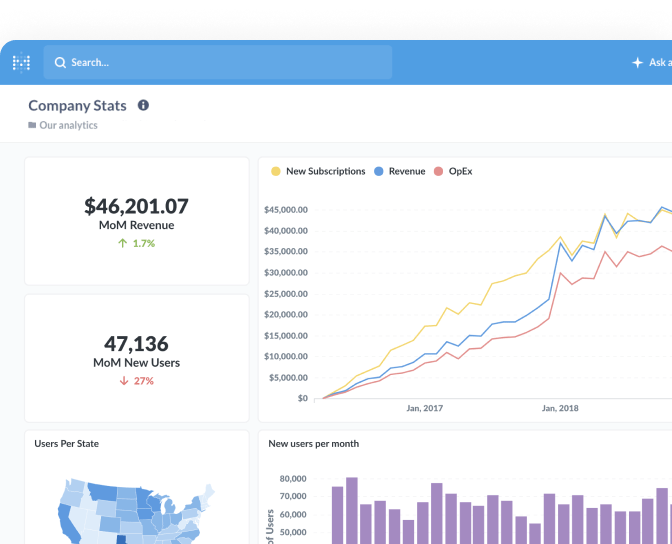


First, a disambiguation: in analytics, “embedding” usually means placing a chart or dashboard inside another application with an iframe. A vector embedding is an unrelated machine learning concept that happens to share the word: a list of numbers produced by a model to represent a piece of content — a sentence, a document, an image — arranged so that similar content ends up close together in space.
The idea
Computers compare numbers easily and meaning with great difficulty. “How do I reset my password?” and “I’m locked out of my account” share almost no words, but they mean nearly the same thing. An embedding model — a neural network trained on enormous amounts of text — maps each piece of content to a point in a high-dimensional space (commonly a few hundred to a few thousand dimensions), and the training objective pushes semantically similar content toward nearby points.
Once meaning is geometry, comparison is arithmetic. The similarity of two texts becomes the distance between their vectors — most often measured by cosine similarity, the angle between them. The two password questions above land close together; either one lands far from “what’s your refund policy?”
What embeddings are used for
Nearest-neighbor search over embeddings is the common engine behind several applications:
- Semantic search. Retrieve documents by meaning rather than keyword overlap, so the locked-out user finds the password-reset article.
- Retrieval for RAG. Documents are chunked and embedded; at question time the query is embedded too, and the closest chunks are fed to a language model as grounding.
- Clustering and deduplication. Group support tickets by theme, or flag near-duplicate records that share no exact fields.
- Recommendations. Items whose embeddings sit near things a user engaged with are reasonable things to show next.
At small scale you can compare vectors by brute force; at large scale they’re stored in a vector database, where approximate nearest neighbor indexes keep similarity search fast.
Practical caveats
Embeddings are model-specific. Vectors from two different embedding models live in unrelated spaces, so comparing them is meaningless — and upgrading your embedding model means re-embedding your whole corpus, a cost worth planning for. Quality also depends on fit: a general-purpose model may blur distinctions that matter in your domain, where “terminal” the airport and “terminal” the shell should not be neighbors.
It’s also worth remembering what an embedding is not: it’s a representation, not a fact store. Nothing about a vector is human-readable, and nothing guarantees the nearest neighbor is correct — only that the model considers it similar. Systems built on embeddings, RAG pipelines especially, are measured by retrieval quality in practice, which is why teams log retrieval hits, distances, and downstream eval results — data that ends up in ordinary databases, where it can be dashboarded like any other operational metric.
Related terms
Put it to work
- LLM analytics — Overview
- LLM observability — Integrations
- Token usage — Metric