What is backlink velocity, and how do you track it in Metabase?
Backlink velocity is the net rate of referring-domain acquisition — domains gained minus domains lost per week or month. It's the rate-of-change companion to referring domains: the total measures where the link profile stands, velocity measures whether link earning is actually outrunning the constant churn of links that die.
TL;DR — Report net, not gross: gained minus lost referring domains per week, smoothed with a rolling four-week average. Loss spikes are usually vendor index recrawls, not real-world losses — verify before reacting — and velocity only compares against your own history, not against sites of a different size.
What does a backlink velocity chart look like in Metabase?
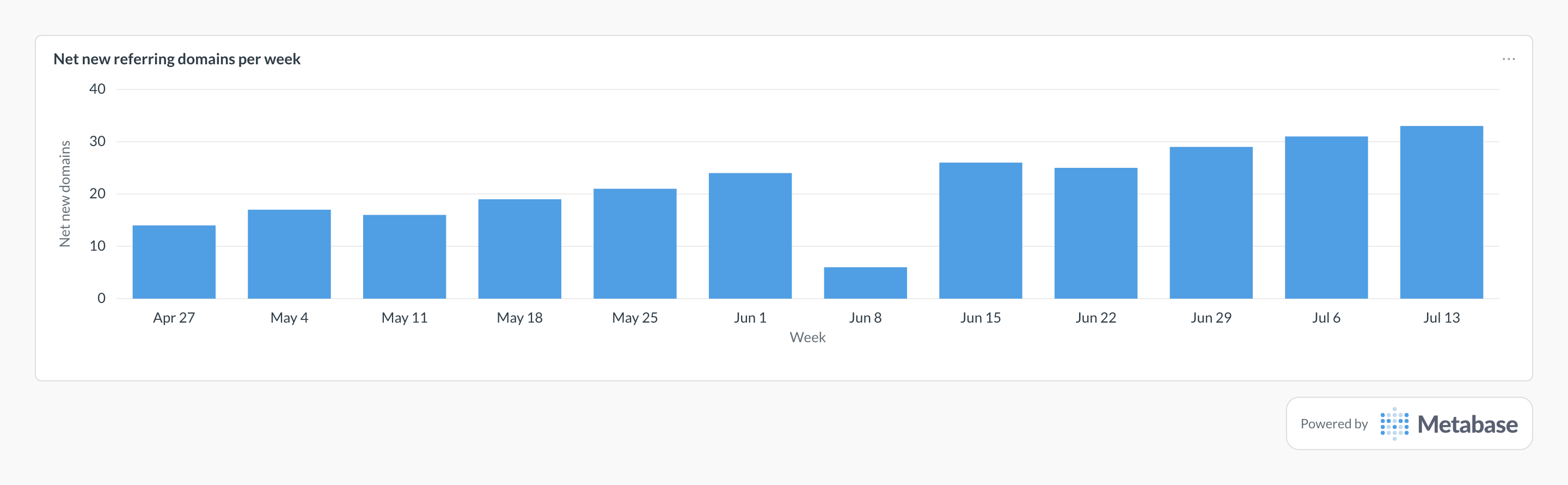
Chart net new referring domains — gained minus lost — per week as bars, and read the direction rather than any single week. The steady climb means link earning is outrunning churn, while a sharp one-week drop like Jun 8’s is usually a vendor index recrawl marking dead links lost, worth verifying before anyone panics.
Backlink velocity as a Metabase card, built from synced Ahrefs backlink data. Figures are illustrative.
What backlink velocity measures
Link profiles are leaky buckets: pages get deleted, links get edited away, domains expire. Velocity measures the fill rate against the leak — the net flow of unique referring domains per period. That framing is what makes it the campaign metric of link building: a content launch or PR push should show up as a velocity step within weeks, long before the referring-domains total or a domain-authority score visibly moves.
Weekly net figures are noisy, so the standard reading is bars for gained and lost with a rolling four-week average over the net line. Direction and acceleration are the signals; the absolute number is site-specific and only comparable to your own history.
What data does it need?
An ahrefs_backlink_changes table with one row per gained or lost referring domain — target_domain, stat_date, referring_domain, and change_type ('gained' or 'lost') — synced daily. Normalize that value on the way in: every query below, and on the backlink growth dashboard, assumes those two labels.
Optionally domain_rating_source per change row, so velocity can be cut by the quality of the domains flowing in and out.
Campaign and launch dates to annotate on the chart — velocity is most useful read against the work that was supposed to move it.
SQL patterns
Gained, lost, and net referring domains by weekPostgreSQL
SELECT
  date_trunc('week', stat_date) AS week,
  COUNT(*) FILTER (WHERE change_type = 'gained') AS gained,
  COUNT(*) FILTER (WHERE change_type = 'lost') AS lost,
  COUNT(*) FILTER (WHERE change_type = 'gained')
    - COUNT(*) FILTER (WHERE change_type = 'lost')
    AS net_new_domains
FROM ahrefs_backlink_changes
WHERE target_domain = 'yourdomain.com'
  AND stat_date >= CURRENT_DATE - INTERVAL '6 months'
GROUP BY 1
ORDER BY 1;
Net velocity with a rolling four-week averagePostgreSQL
WITH weekly AS (
  SELECT
    date_trunc('week', stat_date) AS week,
    COUNT(*) FILTER (WHERE change_type = 'gained')
      - COUNT(*) FILTER (WHERE change_type = 'lost')
      AS net_new_domains
  FROM ahrefs_backlink_changes
  WHERE target_domain = 'yourdomain.com'
    AND stat_date >= CURRENT_DATE - INTERVAL '12 months'
  GROUP BY 1
)
SELECT
  week,
  net_new_domains,
  ROUND(
    AVG(net_new_domains) OVER (
      ORDER BY week
      ROWS BETWEEN 3 PRECEDING AND CURRENT ROW
    ),
    1
  ) AS rolling_4wk_avg
FROM weekly
ORDER BY week;
Pitfalls
Reporting gross gains and hiding churn.→ Gross gained-domains always trends up, which is why it's the number that ends up in slide decks — and why it misleads. A profile gaining 40 and losing 35 domains a week is barely growing. Chart gained, lost, and net together so decay is visible the week it starts.
Treating index-recrawl spikes as real losses.→ Backlink vendors periodically reprune their indexes, marking thousands of links lost in a single pass with no real-world change behind them. Sample the lost domains before sounding an alarm — if the linking pages still exist, it's an artifact — and let the rolling average absorb single-week steps.
Benchmarking velocity across differently sized sites.→ A domain with a million referring domains gains hundreds a week on pure momentum; a young site earning five a week may be outperforming it relative to size. Velocity comparisons only work against your own history or same-scale competitors — never as a raw cross-site league table.
Buying links to move the number.→ Velocity is trivially purchasable, and purchased velocity is worse than none: paid-link footprints invite ranking penalties, and the spike decays as bought links rot. If velocity is a KPI, pair it with a quality cut (gains from high-rating domains) so the incentive points at earning links, not procuring them.
Where this metric applies
Ahrefs + Metabase — the new-and-lost referring-domain feed this metric is built on
The rate at which a site acquires referring domains — net new domains (gained minus lost) per week or month. It's the flow to referring domains' stock: the total tells you where the link profile stands, velocity tells you whether your link earning is accelerating, flat, or quietly losing ground to churn. Count unique domains, not raw backlinks, for the same inflation-resistance reasons.
Why net instead of gross gains?
Because link profiles churn constantly — pages get deleted, links get edited out, domains expire — so a gross gains chart always looks like progress. A site gaining 40 domains a week while losing 35 has a velocity of 5, not 40, and that difference is the entire story. Chart gained, lost, and net on one card; a widening lost series with steady gains is decay that gross-only reporting would hide completely.
What is a good backlink velocity?
There's no universal benchmark — velocity scales with site size, content output, and industry, so a large publisher's baseline would be a startup's miracle quarter. The useful comparisons are internal: your own rolling average over time, velocity before and after a campaign or content launch, and direction relative to competitors tracked in the same vendor's index. Judge acceleration, not the absolute number.
Why did my lost domains suddenly spike?
First suspect the index, not your links. Backlink vendors periodically recrawl and prune their indexes, and those maintenance passes can mark thousands of links "lost" in one week — a phantom loss with no real-world change. Before reporting a loss spike, sample the lost domains: if the pages still exist and still link to you, it's an index artifact. The rolling four-week average exists precisely to keep single-week artifacts from driving conclusions.
How do you track backlink velocity in Metabase?
Sync the new-and-lost referring-domain feed from the Ahrefs API (or daily backlink counts from SE Ranking) into a change table, then chart weekly gained/lost/net bars with a rolling four-week average line over them. Pin it to a backlink growth dashboard next to the referring-domains total and authority trend it feeds.