What are referring domains, and how do you track them in Metabase?
Referring domains is the count of unique domains linking to a target — each domain counted once, however many links it sends. It's the backlink metric that resists inflation: one sitewide footer can add 10,000 backlinks from a single domain, but only breadth of endorsement moves the referring-domain count, which is why it's the one to trend.
TL;DR — Count domains, not backlinks, and track the flow, not just the stock: gained minus lost per month is the honest trend, and gains segmented by the linking domain’s authority are the series your outreach actually moves. A spike in raw counts is as likely to be spam or a sitewide placement as a win.
What does a referring domains chart look like in Metabase?
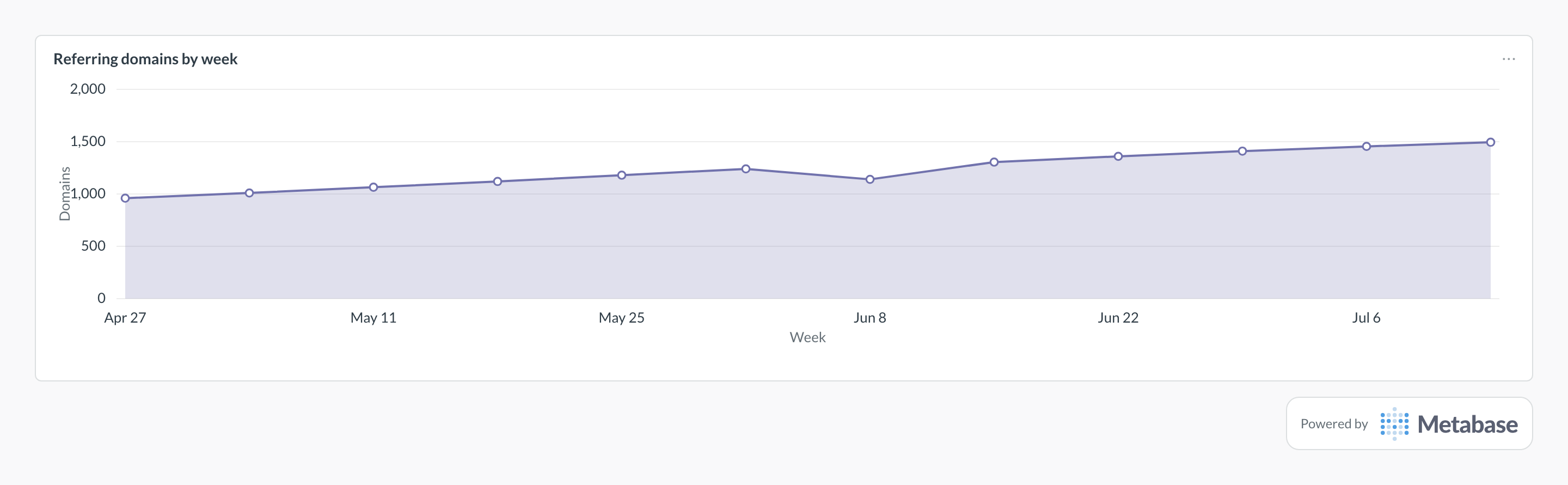
Trend the weekly total of unique linking domains and read the slope: steady accumulation from under 1,000 toward 1,500 means link earning is outpacing link rot. A one-week drop like Jun 8’s usually traces to a single source — a directory delisting or a spam-network purge removing dozens of low-value domains at once — which is why the gained-versus-lost split beats the raw total.
Referring domains as a Metabase card, built from synced backlink-index data. Figures are illustrative.
What referring domains measure
Links work like citations: the breadth of independent sources pointing at you matters more than the raw volume of pointers. The first link from a new domain is a new endorsement; the five-hundredth link from a domain that already links sitewide adds almost nothing. Referring domains counts endorsements, which is why it tracks ranking ability better than the backlink total and why the backlinks-per-domain ratio is worth watching as a sanity check.
The count is a stock, and stocks hide churn — profiles lose domains constantly as pages die and links get edited away. The flow view (domains gained, domains lost, net) tells you whether growth is real, and the lost list is a work queue: high-authority domains that dropped out are often recoverable with one email.
What data does it need?
An ahrefs_authority_daily table with target_domain, stat_date, referring_domains, and backlinks for the running totals.
An ahrefs_backlink_changes table with one row per gained or lost referring domain — referring_domain, change_type ('gained' or 'lost'), stat_date, and domain_rating_source for quality segmentation.
The same snapshots for competitor domains if you benchmark — gaps are only meaningful within one vendor’s link index.
SQL patterns
Referring domains, backlinks, and links-per-domain by weekPostgreSQL
SELECT
  date_trunc('week', stat_date) AS week,
  MAX(referring_domains) AS referring_domains,
  MAX(backlinks) AS backlinks,
  ROUND(
    MAX(backlinks)::numeric
      / NULLIF(MAX(referring_domains), 0),
    1
  ) AS links_per_domain
FROM ahrefs_authority_daily
WHERE target_domain = 'yourdomain.com'
  AND stat_date >= CURRENT_DATE - INTERVAL '12 months'
GROUP BY 1
ORDER BY 1;
Gained vs. lost referring domains by month, with a quality cutPostgreSQL
SELECT
  date_trunc('month', stat_date) AS month,
  COUNT(*) FILTER (WHERE change_type = 'gained') AS gained,
  COUNT(*) FILTER (WHERE change_type = 'lost') AS lost,
  COUNT(*) FILTER (WHERE change_type = 'gained')
    - COUNT(*) FILTER (WHERE change_type = 'lost') AS net,
  COUNT(*) FILTER (
    WHERE change_type = 'gained' AND domain_rating_source >= 50
  ) AS gained_dr50_plus
FROM ahrefs_backlink_changes
WHERE target_domain = 'yourdomain.com'
  AND stat_date >= CURRENT_DATE - INTERVAL '12 months'
GROUP BY 1
ORDER BY 1;
Pitfalls
Counting backlinks when you mean domains.→ A single blogroll placement can add thousands of backlinks from one domain and bend the backlink chart into a hockey stick that means nothing. Lead with referring domains, keep total backlinks as a secondary series, and treat a jump in links-per-domain as a flag, not a win.
Reporting gains and ignoring losses.→ Gross gained-domains charts always go up — profiles churn, so some of that gain is just replacing what quietly fell out. Report gained, lost, and net together, and review the lost list for high-authority domains, which are frequently broken links you can recover.
Equating quantity with quality.→ Fifty scraped-directory domains move the count more than one link from an authoritative industry site, and matter less. Segment gains by the linking domain's rating so quality links are visible as their own series — an unsegmented count rewards exactly the link building you should avoid.
Celebrating spam-link spikes.→ Sudden unexplained gains are more often scraper networks, expired-domain spam, or a negative-SEO blast than organic success. Before reporting a spike, inspect the new domains — if they're low-rating and irrelevant, the right response is to ignore them in reporting, not to take credit.
Where this metric applies
Ahrefs + Metabase — the reference backlink index, with daily authority snapshots and a gained/lost change feed
Semrush + Metabase — backlink summaries with referring-domain counts and Authority Score context
SE Ranking + Metabase — daily new and lost backlink monitoring alongside rank tracking
A unique domain with at least one link pointing at your target, counted once no matter how many links it sends. Backlink tools like Ahrefs report both totals: a site with 500 referring domains and 40,000 backlinks mostly has a few sitewide footers doing the multiplying. Referring domains is the count that tracks genuine breadth of endorsement, which is why it correlates with rankings better than raw backlinks.
Why not just track total backlinks?
Because one domain can add 10,000 sitewide links overnight — a footer or blogroll placement — and move the backlink total without adding meaningful authority. The tenth link from the same domain is worth almost nothing; the first link from a tenth domain is a new endorsement. Chart backlinks per referring domain as a companion ratio: a sudden rise usually means sitewide placements, not outreach success.
Do lost referring domains matter?
Yes — link profiles churn constantly as pages get deleted, links get removed, and domains expire, so gross gains overstate progress. Net change (gained minus lost) is the honest number, and the lost list is an actionable one: a high-authority domain dropping out is often a removed or broken link a single email can restore. That flow view is exactly what backlink velocity trends.
Are all referring domains worth the same?
No — a link from an authoritative, topically relevant site outweighs dozens of directory or spam domains, and low-quality links can spike the count while adding nothing. Segment the count by the authority of the linking domain (the domain_rating_source column): the "gained with DR 50+" series is the one your outreach actually moves. A quantity-only chart rewards exactly the links you don't want.
How do you track referring domains in Metabase?
Sync daily authority snapshots and the gained/lost change feed from the Ahrefs API (or SE Ranking, which tracks new and lost backlinks per day) into your warehouse, then chart the running total, the monthly gained/lost/net flows, and a quality-segmented gains series. Pin them together on a backlink growth dashboard.