What is Domain Rating, and how do you track it in Metabase?
Domain Rating (Ahrefs) — like Semrush's Authority Score and Moz's Domain Authority — is a vendor's 0–100 estimate of a domain's link authority, modeled from that vendor's own crawl of the web. It's useful as a within-vendor trend and a competitor gap, roughly logarithmic in difficulty, and not a number Google uses for anything.
TL;DR — DR is directional within one vendor and meaningless across vendors. The scale is roughly logarithmic — a point at 70 costs far more than a point at 30 — so trend it monthly, read it next to referring domains, and never present it as a Google ranking factor, because it isn’t one.
What does a Domain Rating chart look like in Metabase?
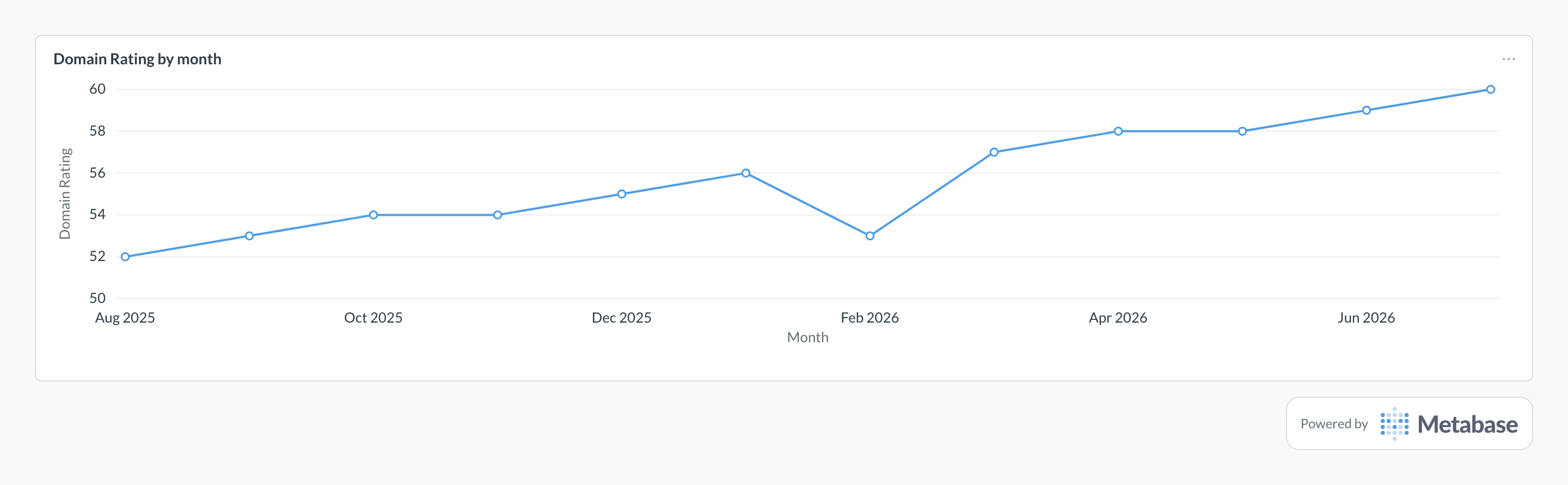
Trend the latest snapshot per month as a line and expect slow movement — the scale is logarithmic, so a handful of points a year at this level is genuine progress. A dip like February’s usually reflects a vendor index update or a batch of lost links, so confirm against referring domains before reacting.
Domain Rating as a Metabase card, built from synced Ahrefs data. Figures are illustrative.
What Domain Rating measures
Each score models the strength of a domain’s backlink profile — chiefly how many unique domains link to it and how authoritative those linkers are, computed recursively over the vendor’s link index. Because the inputs are the vendor’s crawl and the vendor’s model, the score is an estimate of link authority as that vendor sees it: Ahrefs DR, Semrush Authority Score, and Moz DA regularly disagree about the same site, and none of them is the ground truth.
The 0–100 scale is roughly logarithmic, so equal-looking gains are not equal: climbing from 30 to 40 is routine for a site earning links, while 70 to 71 can take a year. That shape makes DR a poor sprint metric and a reasonable strategy metric — the monthly trend and the gap to named competitors, measured in one vendor’s data, are the two readings that hold up.
What data does it need?
An ahrefs_authority_daily table with target_domain, stat_date, domain_rating, ahrefs_rank, referring_domains, and backlinks, snapshotted daily per tracked domain.
The same snapshot for each competitor domain you benchmark against — the gap only means something when both sides come from the same vendor on the same date.
One vendor per chart. If you sync several authority scores, store them in separate columns or tables and never average or overlay them.
SELECT DISTINCT ON (date_trunc('month', stat_date))
  date_trunc('month', stat_date) AS month,
  stat_date AS snapshot_date,
  domain_rating,
  referring_domains
FROM ahrefs_authority_daily
WHERE target_domain = 'yourdomain.com'
  AND stat_date >= CURRENT_DATE - INTERVAL '24 months'
ORDER BY date_trunc('month', stat_date), stat_date DESC;
Latest authority snapshot vs. named competitorsPostgreSQL
SELECT DISTINCT ON (target_domain)
  target_domain,
  stat_date AS snapshot_date,
  domain_rating,
  referring_domains,
  backlinks
FROM ahrefs_authority_daily
WHERE target_domain IN (
  'yourdomain.com', 'competitor-a.com', 'competitor-b.com'
)
ORDER BY target_domain, stat_date DESC;
Pitfalls
Comparing scores across vendors.→ An Ahrefs DR of 62 versus a competitor's Moz DA of 55 is not a comparison — different indexes, different models, different distributions. Benchmark everyone in one vendor's data, and if you report multiple vendors, keep them on separate cards with the vendor named on each.
Presenting DR as a Google ranking factor.→ Google doesn't use any third-party authority score — DR is a vendor's model of your link profile, correlated with ranking ability but causally nothing. Reporting "DR up two points" as an SEO result invites the counter-question the metric can't answer. Report rankings and traffic; let DR explain them.
Reading daily noise as movement.→ Daily DR wobbles with index recrawls and model refreshes on the vendor's side, not with your link building. Chart the month-end snapshot for the trend, keep the daily series for debugging sudden steps, and annotate known vendor algorithm updates before attributing a jump to your own work.
Making DR the goal instead of the byproduct.→ Optimizing DR directly leads to link schemes and directory spam that raise the score without raising rankings or revenue. The defensible chain is links from relevant, authoritative sites → rankings → organic clicks — so pair DR with organic-traffic outcomes, and treat a rising DR with flat traffic as a question, not a win.
Where this metric applies
Ahrefs + Metabase — daily Domain Rating and referring-domain snapshots from the backlink index
Semrush + Metabase — Authority Score alongside backlink summaries, the same role in Semrush’s data
Ahrefs Domain Rating is a 0–100 score of a domain's backlink-profile strength, computed from the quantity and authority of unique domains linking to it within Ahrefs' own index. Semrush Authority Score and Moz Domain Authority are the parallel scores from other vendors — same idea, different index, different model. All are third-party estimates of link authority, not measurements of anything Google publishes.
Is Domain Rating a Google ranking factor?
No. Google does not use Ahrefs DR, Semrush Authority Score, or Moz DA — each is a vendor's model built on that vendor's crawl of the web, and Google has repeatedly said it uses no third-party authority score. These metrics correlate with ranking ability because strong link profiles help both, but a rising DR guarantees nothing about rankings. Treat it as a directional summary of your link profile, not as the objective.
Why is a point of DR harder to gain at 70 than at 30?
The scale is roughly logarithmic: each band up represents a multiplicatively stronger link profile, so moving 70→71 takes far more authority than 30→31. This has two practical consequences. Flat DR at a high level is normal, not stagnation — watch referring-domain counts instead for near-term movement. And a two-point gap between high-DR competitors is a much bigger moat than the same gap between low-DR sites.
Can I compare Ahrefs DR to Semrush Authority Score?
No — a DR of 62 and an Authority Score of 47 for the same site are outputs of different models over different link indexes, and neither is "right." Scores are only meaningful within one vendor: your trend over time in that vendor's data, and your gap versus competitors measured in the same vendor's data. If you sync more than one source, chart them on separate cards and never on a shared axis.
How do you track Domain Rating in Metabase?
Sync a daily authority snapshot from the Ahrefs API (or Semrush, whose Authority Score plays the same role) into a table like ahrefs_authority_daily, then chart a monthly DR trend next to referring domains and your competitor set's latest scores. Pin it to a backlink growth dashboard so authority sits beside the link flows that drive it.