



What is change failure rate, and how do you measure it in Metabase?
Change failure rate is the share of production deployments that cause a failure — one needing a rollback, hotfix, or incident. It's a DORA stability metric that balances the throughput metrics (deployment frequency and lead time for changes). Measure it in Metabase by joining deploys from GitHub or GitLab to incident data.
What does a change failure rate chart look like in Metabase?
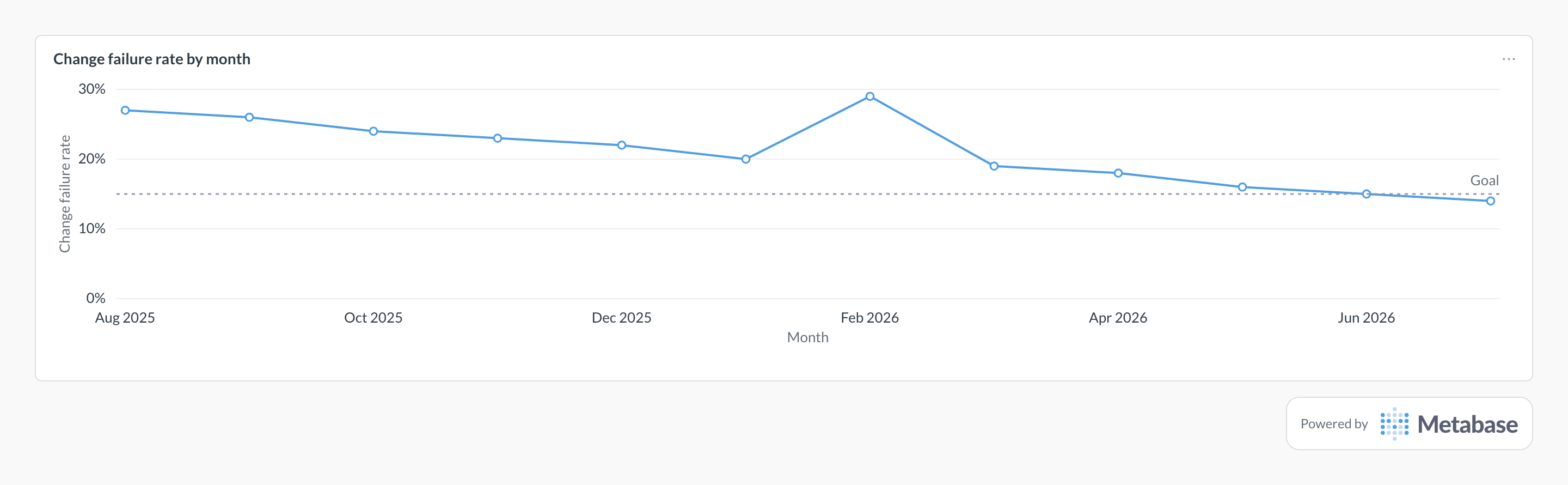
Plot failed production deploys as a share of all production deploys per month, with a goal line at your target band. The slow decline toward 15% is process improvement doing its job, while a spike like Feb 2026's — one bad release train needing rollbacks — is the month worth a retro, not a reason to slow every deploy.
What change failure rate measures
It's the percentage of deployments to production that result in degraded service. It guards against optimizing speed at the expense of quality — a rising frequency with a rising failure rate is a warning, not a win. Report monthly to smooth out small denominators.
- Numerator: deploys linked to an incident, rollback, or hotfix.
- Denominator: all successful production deploys.
- A failed CI run that never reached production is not a change failure.
What data does it need?
-
deployments:environment,status,created_at,repository_id. -
A way to mark failures: an
incidentstable withdeployment_id, oris_rollback/is_hotfixflags on deploys. Incident data usually comes from PagerDuty, Opsgenie, incident.io, or a labeled issue.
SQL patterns
SELECT
  date_trunc('month', d.created_at) AS month,
  COUNT(*)                                          AS deployments,
  COUNT(DISTINCT i.deployment_id)                   AS failed_deployments,
  COUNT(DISTINCT i.deployment_id)::numeric
    / NULLIF(COUNT(*), 0)                           AS change_failure_rate
FROM deployments d
LEFT JOIN incidents i ON i.deployment_id = d.id
WHERE d.environment = 'production'
  AND d.status = 'success'
GROUP BY 1
ORDER BY 1;-- Fallback when incidents aren't linked: count deploys followed
-- by a rollback or hotfix deploy within 1 hour
SELECT
date_trunc('month', d.created_at) AS month,
AVG(
CASE WHEN EXISTS (
SELECT 1 FROM deployments r
WHERE r.repository_id = d.repository_id
AND r.environment = 'production'
AND (r.is_rollback OR r.is_hotfix)
AND r.created_at BETWEEN d.created_at AND d.created_at + INTERVAL '1 hour'
) THEN 1.0 ELSE 0.0 END
) AS change_failure_rate
FROM deployments d
WHERE d.environment = 'production' AND d.status = 'success'
GROUP BY 1
ORDER BY 1;Pitfalls
COUNT(DISTINCT deployment_id).
Where this metric applies
- GitHub + Metabase — deploys joined to incidents or rollback workflows
- GitLab + Metabase — pipeline deployments joined to incidents
- Sentry + Metabase — releases joined to error spikes and regressions
- PagerDuty + Metabase — the incident half of the failure link
Related
Metrics
Integrations
Dashboards
Terms
FAQ
What is change failure rate?
What counts as a failure?
How do I link a deploy to an incident?
deployment_id (or release tag/SHA) on the incident record when it's opened in PagerDuty or your incident tool. Fallback: infer failures from a rollback or hotfix deploy shortly after the original release — the second SQL pattern above does this with a one-hour window. Deploy records come from GitHub Deployments/Actions or GitLab environments; attribute each incident to a single deploy to avoid double-counting.What's a good change failure rate?
How do you track change failure rate in Metabase?
deployments and incidents tables with a join key, and define the rate once as a saved question — failed deploys over total production deploys by month. The SQL patterns above cover both the incident-linked and rollback-fallback versions. Put the result on a software delivery dashboard next to the other DORA keys.