




What is cycle time, and how do you measure it in Metabase?
Cycle time is the elapsed time from when work starts
to when it's done (completed_at − started_at).
It measures active working time — how long an item takes once someone picks
it up — and is the most actionable flow metric for engineering teams.
Measure it in Metabase from issue-tracker data synced into a database (Linear or Jira).
started_at (or status history). Lead time = created →
done. Always report median (p50) and p90, not the average.
What does a cycle time chart look like in Metabase?
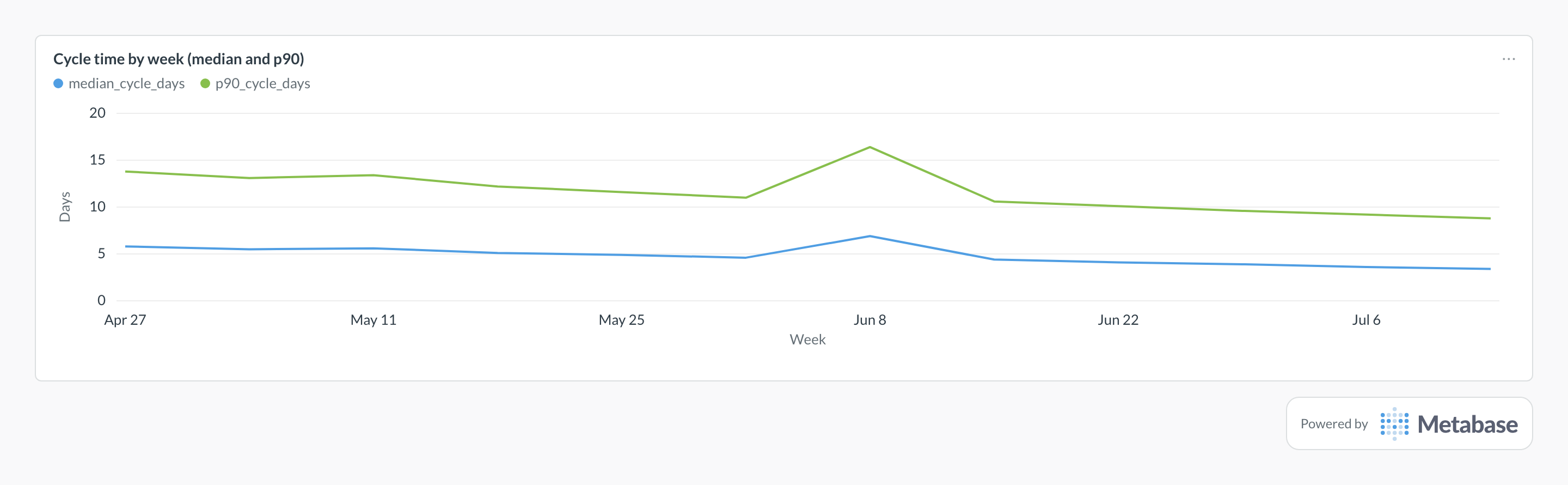
Plot median and p90 cycle time per completion week as lines and watch both fall — the gap between them is your predictability, and here it narrows from about eight days to five. A one-week spike like Jun 8's usually means a batch of long-stalled items finally got closed, landing all their age on the week they finished, not that the team suddenly slowed down.
Why cycle time needs status history
started_at isn't always a stored column. The reliable way to know
when work started is the status-change history: the first
transition into an "in progress" state. If you only have a single resolved/completed_at timestamp, you cannot compute true
cycle time — fall back to
lead time and add a caveat.
- Linear: use
started_atif populated, or derive it from issue history (first move to astartedworkflow state). - Jira: derive from
issue_changelog(first transition to an In Progress status); don't useresolvedalone.
What data does cycle time need?
-
A reliable
started_at, ideally from status-change history. completed_atand a clear "done" definition.- For time-in-status breakdowns, the full status history (not just start/end).
SQL patterns
SELECT
  date_trunc('week', completed_at) AS week,
  percentile_cont(0.5) WITHIN GROUP (
    ORDER BY EXTRACT(EPOCH FROM (completed_at - started_at)) / 86400.0
  ) AS median_cycle_days,
  percentile_cont(0.9) WITHIN GROUP (
    ORDER BY EXTRACT(EPOCH FROM (completed_at - started_at)) / 86400.0
  ) AS p90_cycle_days
FROM issues
WHERE state_type = 'completed'
  AND started_at IS NOT NULL
GROUP BY 1 ORDER BY 1;
Pitfalls
started_at. →
Without it (or history), you're really measuring lead time — say so.
Where this metric applies
- Linear + Metabase —
started_ator firststartedworkflow state - Jira + Metabase — first In Progress transition in the changelog
Related
Dashboards
Metrics
Terms
FAQ
Can I measure cycle time without status history?
started_at exists — a timestamp for when work actually began. If all you have is a created date and a resolved/completed date, you're really measuring lead time, not cycle time. The reliable source for started_at is the status-change history: the first transition into an in-progress state (Jira's issue_changelog, Linear issue history). Without it, report lead time and caveat the gap.