





What is gross revenue retention (GRR)?
What does a gross revenue retention chart look like in Metabase?
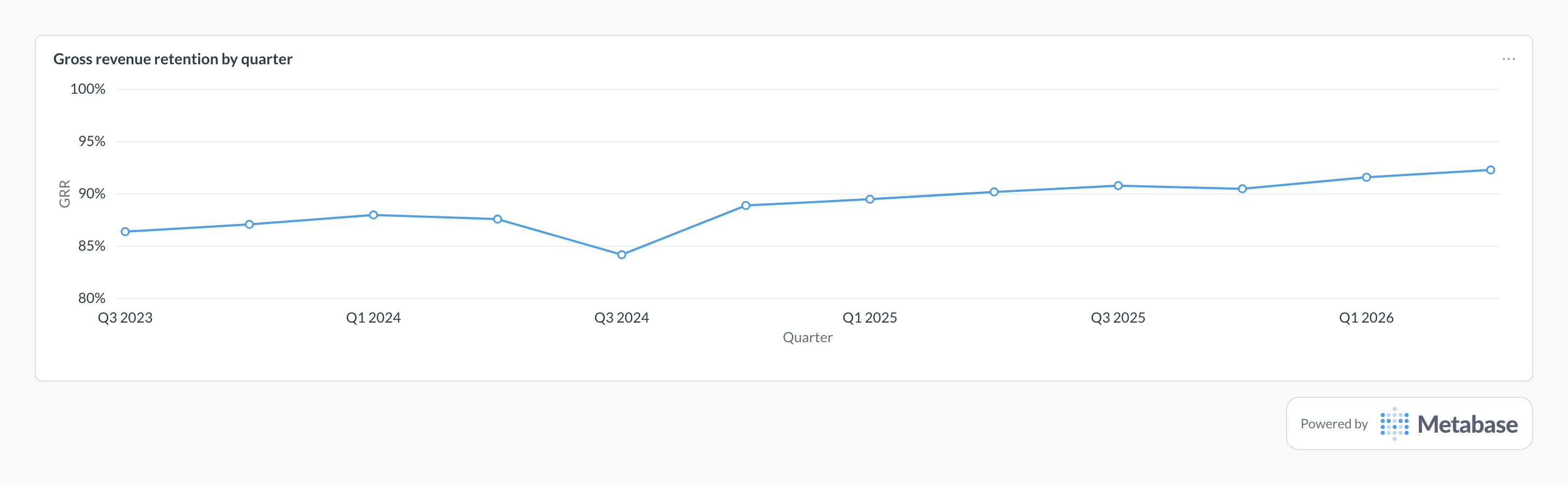
GRR can only approach 100% from below, so read the gap to the top of the chart — the slow climb from 86% toward 92% means fewer dollars leaking out of the existing base each quarter. A sharp one-quarter drop like Q3 2024’s is usually one large contract expiring rather than a broad churn wave, which is why it is worth segmenting by plan and contract length before treating it as a trend.
Definition
Gross revenue retention is the share of recurring revenue from an existing cohort of customers that survives a period, counting churn and downgrades but never expansion. Because the numerator can only shrink, GRR is capped at 100% — it measures how leaky the bucket is, with none of the credit for pouring more water in.
What data do you need?
- Subscription records with ARR or MRR and effective date ranges
- A cohort definition: customers active at the start of the period
- Churn and downgrade events dated to when they take revenue effect
- Expansion amounts identified separately so they can be excluded
- A stable account key that survives renewals, upgrades, and entity renames
SQL pattern
-- Expansion is deliberately excluded: GRR is capped at 100% by design.
WITH periods AS (
  SELECT
    d::date AS period_start,
    (d + INTERVAL '3 months')::date AS period_end
  FROM generate_series(
    date_trunc('quarter', CURRENT_DATE) - INTERVAL '2 years',
    date_trunc('quarter', CURRENT_DATE) - INTERVAL '3 months',
    INTERVAL '3 months'
  ) AS d
), starting AS (
  SELECT
    p.period_start,
    s.account_id,
    SUM(s.arr_usd) AS start_arr
  FROM periods p
  JOIN subscriptions s
    ON s.started_at < p.period_start
   AND (s.ended_at IS NULL OR s.ended_at >= p.period_start)
  GROUP BY 1, 2
), ending AS (
  SELECT
    p.period_start,
    s.account_id,
    SUM(s.arr_usd) AS end_arr
  FROM periods p
  JOIN subscriptions s
    ON s.started_at < p.period_end
   AND (s.ended_at IS NULL OR s.ended_at >= p.period_end)
  GROUP BY 1, 2
)
SELECT
  st.period_start,
  ROUND(SUM(st.start_arr), 2) AS starting_arr,
  ROUND(SUM(LEAST(COALESCE(en.end_arr, 0), st.start_arr)), 2)
    AS retained_arr,
  ROUND(
    100.0 * SUM(LEAST(COALESCE(en.end_arr, 0), st.start_arr))
    / NULLIF(SUM(st.start_arr), 0), 1
  ) AS grr_pct
FROM starting st
LEFT JOIN ending en
  ON en.period_start = st.period_start
 AND en.account_id = st.account_id
GROUP BY st.period_start
ORDER BY st.period_start;
Common pitfalls
Where does this metric apply?
This metric commonly uses data from Stripe, Chargebee, Salesforce, Gainsight, Planhat, plus any warehouse models built on account, subscription, and product-usage tables at the same grain.