





What is no-show rate for booked meetings?
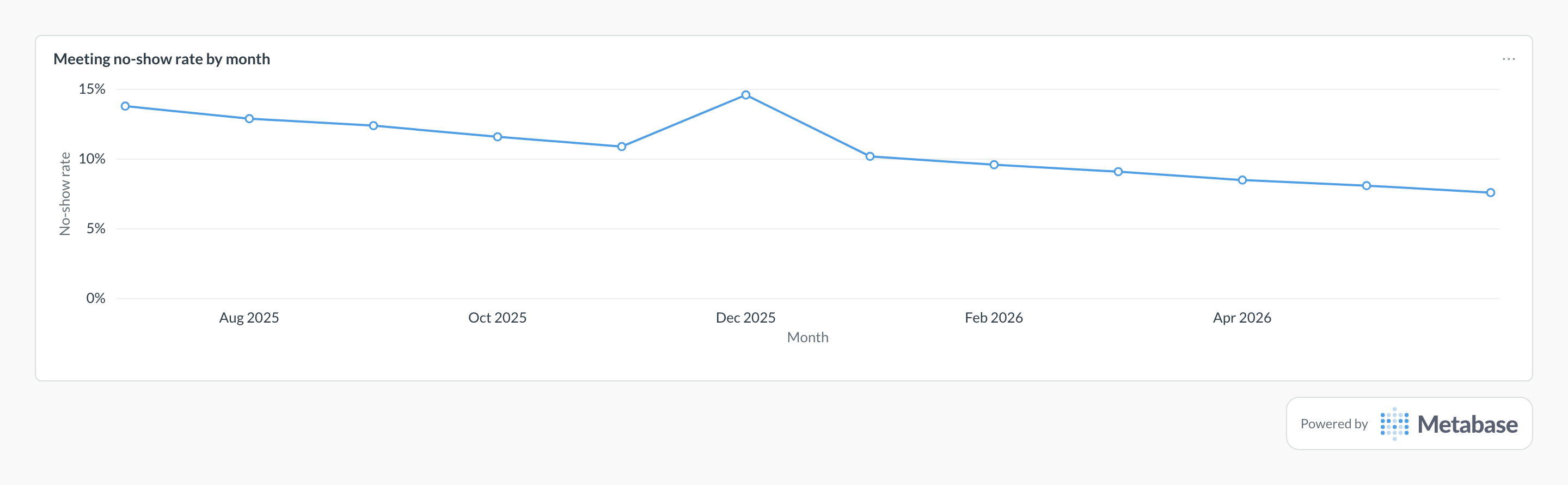
What does a no-show rate chart look like in Metabase?
The denominator is meetings actually due — cancellations and reschedules already removed — so the fall from about 14% to under 8% reflects real attendance improving as reminders and shorter lead times do their work. A spike like Dec 2025’s is the seasonal signature of holiday-week bookings rather than a regression, and it is worth segmenting by meeting type before acting on it.
Definition
No-show rate is the share of booked meetings that neither party attended — the invitee did not cancel, did not reschedule, and did not turn up. It is a scheduling-funnel metric, and it is only measurable if your data distinguishes cancellations, reschedules, and actual attendance. Where attendance is not recorded, you can measure cancellation rate honestly, but not no-shows.
What data do you need?
- Scheduled meeting records with booking, start, and status timestamps
- A status that separates cancelled, rescheduled, completed, and no-show
- An attendance or check-in signal — join events, host disposition, or a CRM outcome field
- The rescheduled-from link, so a moved meeting is not counted twice
- Meeting type, host, and booking source for segmentation
SQL pattern
-- Rescheduled bookings are excluded from the denominator: the moved
-- meeting appears again as its own row, and counting both double-counts
-- a single intended meeting.
SELECT
  date_trunc('month', m.starts_at)::date AS month,
  m.meeting_type,
  COUNT(*) FILTER (
    WHERE m.status IN ('completed', 'no_show')
  ) AS meetings_due,
  COUNT(*) FILTER (WHERE m.status = 'no_show') AS no_shows,
  COUNT(*) FILTER (WHERE m.status = 'cancelled') AS cancelled,
  ROUND(
    100.0 * COUNT(*) FILTER (WHERE m.status = 'no_show')
    / NULLIF(COUNT(*) FILTER (
        WHERE m.status IN ('completed', 'no_show')
      ), 0), 1
  ) AS no_show_rate_pct,
  ROUND(
    100.0 * COUNT(*) FILTER (WHERE m.status = 'cancelled')
    / NULLIF(COUNT(*), 0), 1
  ) AS cancellation_rate_pct
FROM scheduled_meetings m
WHERE m.starts_at >= CURRENT_DATE - INTERVAL '12 months'
  AND m.starts_at < CURRENT_DATE
  AND m.rescheduled_to_id IS NULL
GROUP BY 1, 2
ORDER BY 1, no_show_rate_pct DESC;
Common pitfalls
Where does this metric apply?
This metric commonly uses data from Calendly, Cal.com, Google Calendar, Salesforce, HubSpot, plus any warehouse models built on account, subscription, and product-usage tables at the same grain.