





What is effective savings rate (ESR)?
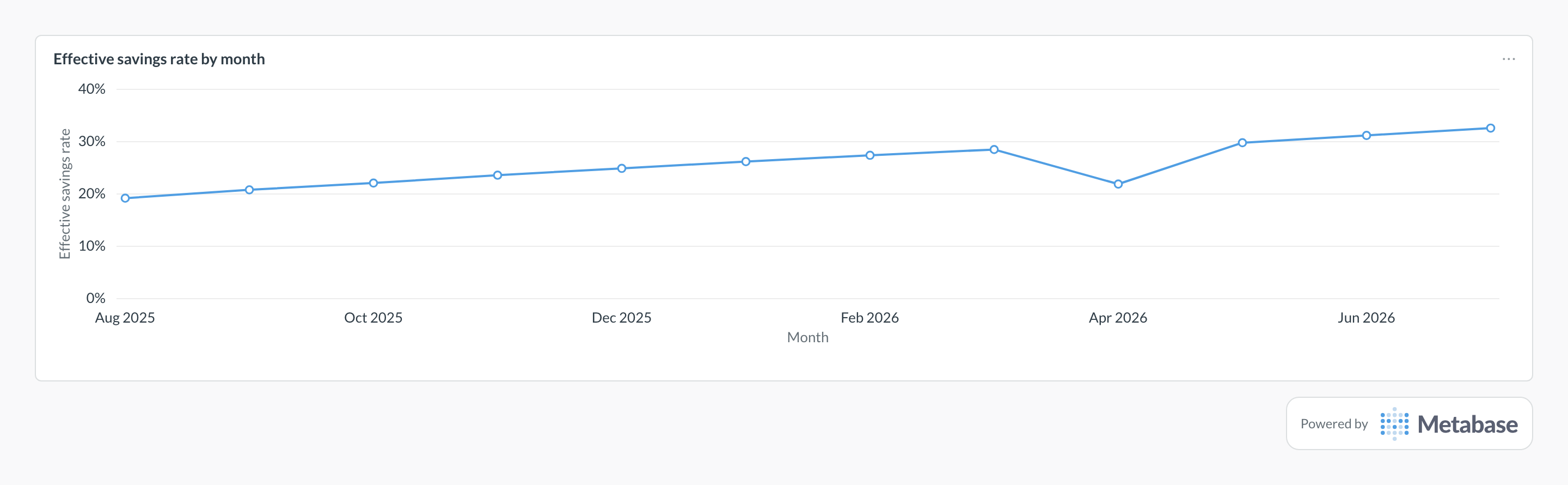
What does an effective savings rate chart look like in Metabase?
Watch the level and the slope together: a rising line means commitments and negotiated discounts are converting into realized savings on real usage. A dip like April’s with coverage unchanged points at utilization — a rightsized fleet left part of a commitment idle that month, and idle commitment is negative savings.
Definition
Effective savings rate is the discount you actually achieve: realized savings divided by what the same usage would have cost at on-demand rates. It rolls coverage, utilization, and discount quality into one honest number — you can have great coverage and still a poor ESR if commitments are underused or badly scoped.
What data do you need?
- Actual amortized cost per line item
- On-demand-equivalent (public) rates for the same usage
- Pricing model per line to attribute savings to programs
- Unused commitment cost, which subtracts from realized savings
- Negotiated discount data where applicable
SQL pattern
SELECT
  date_trunc('month', usage_date) AS month,
  ROUND(SUM(on_demand_equivalent_usd), 2) AS on_demand_equivalent,
  ROUND(SUM(amortized_cost_usd), 2) AS actual_cost,
  ROUND(
    100.0 * (SUM(on_demand_equivalent_usd) - SUM(amortized_cost_usd))
    / NULLIF(SUM(on_demand_equivalent_usd), 0), 1
  ) AS effective_savings_rate_pct
FROM billing_line_items
WHERE is_commitment_eligible
GROUP BY 1
ORDER BY 1;
Common pitfalls
Where does this metric apply?
This metric commonly uses data from AWS Billing, Google Cloud Billing, Vantage, plus any warehouse models built on raw billing exports at the same grain.